British-induced famines in India
31 recurring mass starvation shaped by colonial extraction, unequal access to food and failures of relief.
- When
- 1765–1947
- Where
- Indian subcontinent under East India Company and British Crown rule
Across the colonial period, harvest crises became catastrophes for people without secure access to food, water or assistance. British revenue demands, market policies and relief decisions shaped the consequences. This overview connects the famines while distinguishing their regional causes, disputed death tolls and changing forms of government.
Background
A changing colonial system
Company rule and Crown rule were different phases of an expanding empire. The East India Company acquired revenue-collection rights in Bengal in 1765; the Crown took over government in 1858. Colonial control was not uniform across the subcontinent. A famine occurring during this period does not establish that every affected district was administered directly by Britain.[7]
How policy increased vulnerability
Land-revenue demands and the restructuring of rural economies could weaken households before a harvest failed. When prices rose and earnings collapsed, grain being available for sale did not make it affordable. Colonial priorities over revenue and expenditure helped determine who could survive a shortage and what assistance reached them.[4]
What happened
- 1769–1770
Bengal: famine under Company government
Harvest failure struck soon after the Company acquired Bengal’s revenue rights. Inadequate relief and the pressure of taxation formed part of the disaster. The traditional claim of ten million deaths is contested; it should not be treated as a reliable census total. The individual Bengal account records that uncertainty.[7]
- 1876–1878
Drought and contested relief
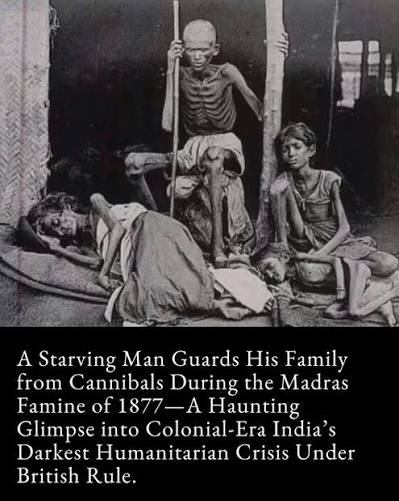
Severe drought devastated southern India and adjoining regions. Colonial relief policy became a confrontation over the cost of assistance and the food workers needed to survive. Richard Temple and medical officer W. R. Cornish disputed relief wages and nutritional requirements, exposing conflicts within the administration itself.[3]
- 1896–1897 and 1899–1900
Repeated crises of food and water
Further major famines struck the Deccan and other regions. Tirthankar Roy emphasises the loss of drinking water, contaminated supplies, disease and migration alongside food scarcity. His analysis challenges explanations based on grain distribution alone, without treating political decisions as irrelevant.[2]
- 1943–1944
Bengal: wartime priorities and failure of protection
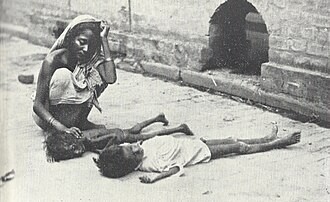
Burma’s occupation, damage to rice crops, hoarding and disrupted transport combined with inflation and failures of distribution. British wartime government and Bengal’s administration failed to protect people losing access to food. M. S. Swaminathan’s account identifies both governance failures and the UK government’s indifference, with an estimated 1.5–3 million deaths.[5]
Impact & evidence
What the figure of 31 actually refers to
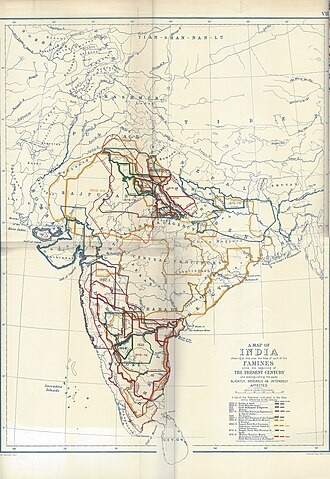
In an essay published in Agenda in 2006, Mike Davis cites an 1878 statistical study reporting 31 serious famines over 120 years of British rule. It is a historical tally, not a verified list of 31 events covering the whole period through 1947. Its date necessarily excludes the 1943 Bengal famine. Comparisons with much earlier centuries also depend on the completeness of surviving records.[1]
Drought does not settle the question of blame
Davis argues that incorporation into markets serving colonial interests weakened food security and increased vulnerability to climatic shocks. Roy assigns greater weight to water scarcity in the Deccan. The historical question is therefore not exhausted by naming a failed monsoon: it also requires tracing taxation, access to supplies, relief and the decisions that left people unprotected.[1]
Millions of deaths, without a spurious grand total
Roy estimates 20–22 million deaths across the three late-nineteenth-century Deccan famines discussed in his study. This is an attributed estimate, not a complete colonial-period total. Different accounts cover different territories and years; deaths from disease, migration and population deficits must not be combined indiscriminately. Bengal’s wartime famine requires its own accounting.[2]
Explore the documented cases
The linked accounts of Bengal in 1770, the Great Famine of 1876–1878 and Bengal in 1943 provide separate chronologies and evidence. Chalisa and Doji Bara are also covered on Famoose, but their changing political geography should not be flattened into a claim of uniform British administration.[8]
Aftermath & legacy
Relief became a question of political legitimacy
Indian newspapers and emerging nationalist organisations challenged the colonial state using its own statistics. Disputes about relief wages and mortality were arguments about governmental responsibility, not simply disagreements over arithmetic. Critics inside the administration also contested the adequacy of relief.[3]
Food security after empire
The Bengal catastrophe helped make food provision central to the demand for self-government and to the responsibilities of independent India. Its legacy extends into debates about public distribution, relief and the right to food. Preventing mass famine and ending persistent hunger are related but distinct tasks.[6]
Sources & image credits (11)
- Mike Davis — How famine was created, Agenda 6 (2006), printed page 22 ↗
- Tirthankar Roy — Famines in India: Enduring Lessons (2021) ↗
- David Hall-Matthews — Inaccurate Conceptions (2008) ↗
- Cambridge University Press — Development, Poverty & Famines ↗
- M. S. Swaminathan — From Bengal Famine to Right to Food ↗
- Benjamin Robert Siegel — The Bengal Famine and the Nationalist Case for Food ↗
- Famoose — Great Bengal famine (1769–1770) ↗
- Famoose — Great Famine of 1876–1878 (1876–1878) ↗
- Famoose — Bengal famine (1943–1944) ↗
- Famoose — Chalisa famine (1783–1784) ↗
- Famoose — Doji Bara famine (1791–1792; wider crisis from the late 1780s) ↗
Supplied by the site owner. Original photographer and reproduction source not independently established; overlaid text is part of the supplied image.