Great Famine of 1876–1878
Drought and hunger intensified by restrictive colonial relief and inadequate support.
- When
- 1876–1878
- Where
- Southern and western India, with wider affected regions
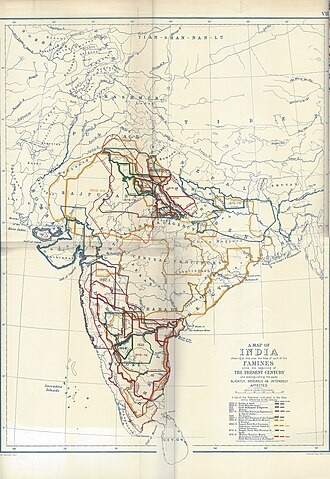
A severe drought struck much of southern India, including Madras and Bombay presidencies. Hunger and disease spread as livelihoods collapsed. Colonial authorities organised relief works, but strict eligibility tests and low support made access difficult for people already weakened by deprivation.
Background
Drought becomes destitution
Research on Ahmednagar in Bombay Presidency traces the famine through drought, migration and mortality. It treats famine as a developing social process, not a sudden event explained by weather alone.[1]
What happened
- 1876
A spreading emergency
Crop and income losses drove households towards relief and migration. Responses differed between districts and provincial administrations.[1]
- 1877
The relief wage dispute
Richard Temple pressed for reduced relief allowances. Officials debated how much food labourers required, while work and distance tests were intended to discourage applications from people judged capable of supporting themselves.[2]
- 1878 and after
Medicine and administration
The famine strengthened debate over the state's duties and medical expertise in relief. Research on Madras shows provincial implementation and medical intervention shaping policy, rather than a single uniform administration.[3]
Impact & evidence
Labour as a condition of survival
Public works offered subsistence through employment. Requiring exertion from undernourished applicants made the design of wages, rations and admission tests matters of survival.[2]
At least five million deaths
Cambridge’s Whipple Museum gives at least five million deaths in India during 1876–1878 under British Crown rule. This estimate concerns this famine, not the larger total for the series of Indian famines extending into the early twentieth century. Drought affected food production, while relief policy and households’ access to food shaped the resulting mortality.[4]
Aftermath & legacy
Different places, different losses
Regional studies prevent the experience of one presidency from standing for every affected area. They also make visible migration and disease alongside deaths directly attributed to starvation.[1]
Relief was a political choice
Debates about minimum rations and eligibility determined who could obtain help and on what terms. Officials’ fear of excessive expenditure or dependence could conflict with the immediate needs of people already weakened by hunger. The famine is therefore a history of decisions about public responsibility as well as a history of failed rain.[3]
Sources & image credits (4)
- Oxford University Research Archive — Famine process and famine policy ↗
- Aidan Forth — Detention and relief at Indian famine camps ↗
- UCL — Famine, disease, medicine and the state in Madras ↗
- whipplemuseum.cam.ac.uk — historical research ↗
Stanford's Geog. Etab. London; Public domain; via Wikimedia Commons. Image source ↗