Bengal famine
Mass starvation during wartime, shaped by colonial priorities and unequal access to food.
- When
- 1943–1944
- Where
- Bengal, British India; now Bangladesh and India
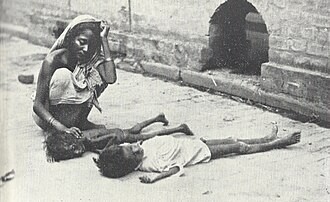
Bengal's famine killed people through hunger and associated disease while wartime demand and inflation put food beyond many households' reach. Disruption of rice supplies, crop damage, hoarding and failures of relief formed an interacting crisis.
Background
War and vulnerability
Japan's conquest of Burma interrupted rice supplies. Wartime demand and rising prices put poorer households at a disadvantage, while government responses failed to secure adequate access to food.[1]
Food on sale was not food within reach
The crisis struck households unequally. People who depended on wages or selling services could lose access to rice when its price rose faster than their income. Selling possessions, migrating and seeking relief could delay starvation without restoring a livelihood. This helps explain why visible food in a market could coexist with people dying nearby: production and imports mattered, but so did the ability to buy and distribute food.[1]
What happened
- 1942
Supply disruption
The loss of Burmese imports and damage to Bengal's rice crop contributed to pressure on supplies. Historians disagree about the size and importance of the harvest shortfall.[2]
- 1943
Hunger and delayed relief
Rice-price increases, hoarding and failures of distribution intensified the emergency. Provincial and central authorities responded too slowly as rural deprivation became mass destitution.[1]
- 1944–1945
An official investigation
The Famine Inquiry Commission investigated the crisis and published its Bengal report in 1945. It became a central source for later arguments about administrative failure and food availability.[3]
Impact & evidence
Estimated human loss
Approximately 3 million people died from starvation and famine-related disease, according to the study Colonial Biopolitics and the Great Bengal Famine of 1943. This is an estimate, not a complete count of individual deaths.[1]
Availability and purchasing power
Mark Tauger emphasises crop failure and shortage. Other research stresses wartime governance and distribution. These explanations address different parts of a crisis in which food availability and people's ability to obtain it both mattered.[2]
Aftermath & legacy
Responsibility across institutions
The history involves British imperial decision-makers, the Government of India and Bengal's provincial administration. Specifying their decisions is more informative than attributing the disaster to weather alone or to an unsupported single cause.[1]
Disease prolonged the emergency
The famine’s human cost included deaths from illnesses made more dangerous by hunger, destitution and displacement. Restoring supplies did not immediately restore health or rebuild families’ resources. The 1945 inquiry therefore belongs to a longer aftermath of administrative investigation and arguments about responsibility, not simply a moment when the harvest improved.[1]
Sources & image credits (3)
- Colonial Biopolitics and the Great Bengal Famine of 1943 ↗
- Mark B. Tauger — Entitlement, Shortage and the 1943 Bengal Famine ↗
- University of North Bengal — Famine Inquiry Commission report, 1945 ↗
The Statesman, Calcutta, India; Public domain; via Wikimedia Commons. Image source ↗