Tulsa race massacre
A white mob destroying Greenwood, a prosperous Black neighbourhood, through murder and arson.
- When
- 31 May–1 June 1921
- Where
- Tulsa, Oklahoma, United States
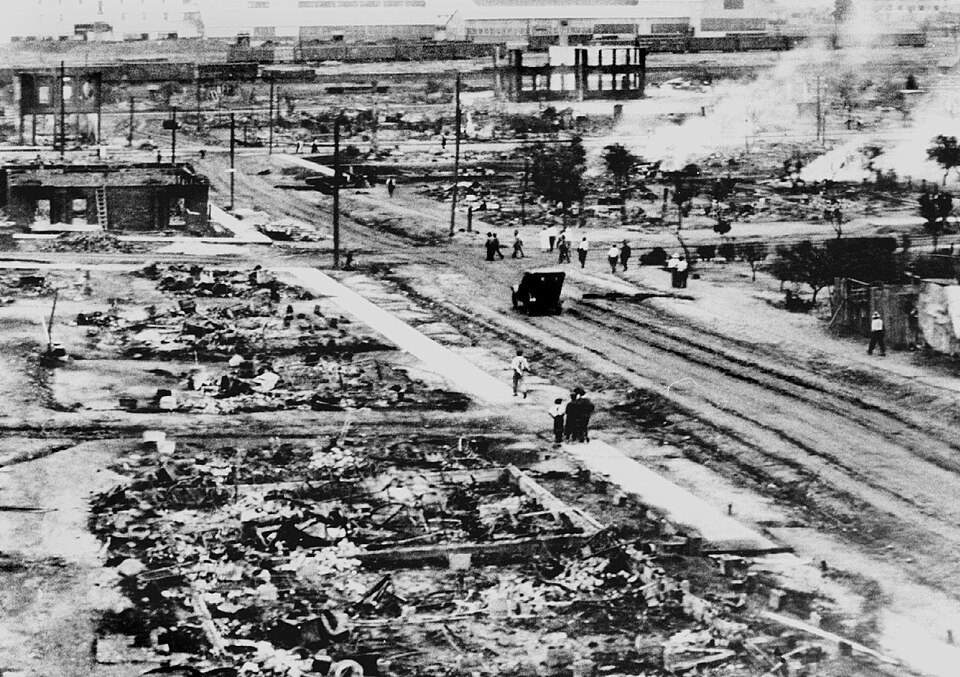
A white mob destroying Greenwood, a prosperous Black neighbourhood, through murder and arson. Greenwood's businesses and institutions developed within a segregated city where Black residents faced discrimination and threats of lynching. An allegation involving a young Black man, Dick Rowland, and a white woman triggered a gathering at the courthouse.
Background
Prosperity under segregation
Greenwood's businesses and institutions developed within a segregated city where Black residents faced discrimination and threats of lynching. An allegation involving a young Black man, Dick Rowland, and a white woman triggered a gathering at the courthouse. Armed Black residents arrived out of concern that Rowland would be lynched.[1]
What happened
- 31 May 1921
Confrontation becomes an assault
A clash near the courthouse escalated into attacks on Black residents. White mobs, including men deputised by local authorities, moved against Greenwood. The violence was not a balanced confrontation between equivalent communities: organised attackers targeted homes, businesses and residents in the Black district.[1]
- 1 June 1921
Greenwood burns
More than thirty-five blocks were devastated. Residents fled, while authorities detained large numbers of Black people. Destruction extended beyond buildings to medical facilities, community records, livelihoods and the security of families who had invested in the neighbourhood.[1]
Impact & evidence
An incomplete record
The Museum of Tulsa History describes credible evidence for approximately 100–300 deaths, while documented named totals are lower. Records were incomplete and many deaths were not properly registered. The difference is why a confirmed list and an estimated overall toll should be reported separately rather than substituted for one another.[2]
Aftermath & legacy
Rebuilding without adequate redress
Survivors rebuilt despite financial losses, obstacles to compensation and efforts to minimise the event. For decades, the massacre received little public acknowledgment. Survivor testimony, historical investigations and grave searches challenged that silence. Its legacy includes not only the immediate violence but the loss of property and opportunity carried into later generations.[1]
Sources & image credits (3)
- Wikipedia — Tulsa race massacre ↗
- Museum of Tulsa History — 1921 massacre and evidence ↗
- Oklahoma Historical Society — Tulsa Race Massacre ↗
Photographer unidentified · Public domain (source record). Resized for display. Image source ↗