Herero and Nama genocide
Germany's colonial extermination campaign against Ovaherero and Nama communities.
- When
- 1904–1908
- Where
- German South West Africa, present-day Namibia
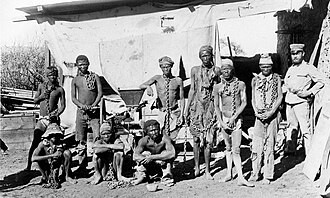
German colonial forces responded to resistance in South West Africa with an extermination order and a concentration-camp system. Killing, forced labour, malnutrition and disease devastated Ovaherero and Nama communities. Racial research also exploited victims' remains.
Background
Colonial violence and resistance
The Mémorial de la Shoah traces the 1904 uprising to colonial restrictions and settlers' abuses. Ovaherero resistance was followed by Nama armed resistance against German rule.[1]
Settler power and resistance
German colonial rule imposed control over land, labour and movement. Settler abuses and restrictions provoked resistance; military commanders then targeted the wider populations from which that resistance arose. Driving families from their means of subsistence and imprisoning survivors extended the violence beyond a confrontation between armed forces.[2]
What happened
- 1904
An extermination order
On 2 October, General Lothar von Trotha issued an order targeting the Herero. Its scope placed men, women and children in danger, turning military repression into a campaign against a people.[1]
- 1905–1908
Concentration camps
Prisoners were held at sites including Windhoek, Swakopmund and Shark Island. Forced labour, mistreatment, inadequate nutrition and disease caused further deaths.[1]
- 2017
Continuing consequences
A UN working-group report examined the enduring impact of the genocide, including dispossession and affected communities' demands for redress.[2]
Impact & evidence
A racialised system
Human remains were sent to Germany for racial research. The history extends beyond battlefield killing to the treatment of prisoners and the appropriation of victims' bodies.[1]
Estimated deaths and dispossession
A 2017 UN working-group report cites historical estimates of more than 65,000 Ovaherero and 10,000 Nama killed. These figures encompass people driven into the desert to die from thirst and hunger as well as other deaths caused by the campaign. They are historical estimates rather than a complete register of named victims. Survivors also lost land and livestock, so the consequences cannot be measured by mortality alone.[2]
Aftermath & legacy
Land, memory and redress
Descendants' claims concern the loss of land, lives and community resources as well as acknowledgment. The UN report places those demands within the continuing consequences of colonial rule.[2]
Sources & image credits (2)
- Mémorial de la Shoah — Herero and Nama, 1904–1908 ↗
- UN Working Group of Experts on People of African Descent — Germany report ↗
Unknown author Unknown author; Public domain; via Wikimedia Commons. Image source ↗