South Africa's Constitution
An enforceable rights framework replacing apartheid's legal order.
- When
- 1996; effective 1997
- Where
- South Africa
An enforceable rights framework replacing apartheid's legal order. The 1994 election took place under an interim constitution. A democratically elected Constitutional Assembly then prepared a final text within agreed constitutional principles.
Background
Negotiated transition required lasting rules
The 1994 election took place under an interim constitution. A democratically elected Constitutional Assembly then prepared a final text within agreed constitutional principles. This process sought to move from a negotiated transition to durable institutions capable of constraining government and protecting rights.[1]
What happened
- 1994–1996
Drafting and public participation
The assembly considered submissions and debated the distribution of power. The resulting document included civil and political rights alongside social and economic rights. Its structure reflected compromise and public engagement rather than the preferences of one leader alone.[1]
- 1996–1997
Certification and commencement
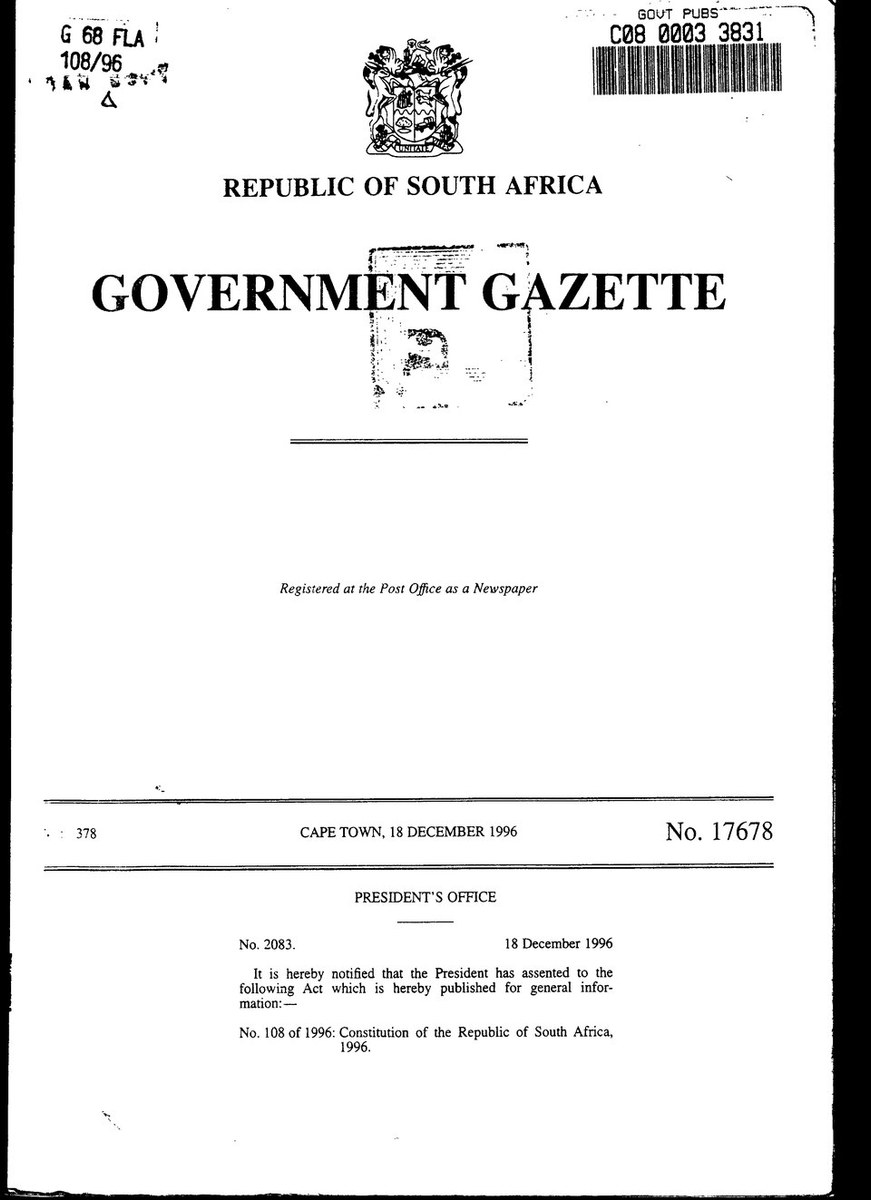
The Constitutional Court reviewed the text against the agreed principles and initially required changes. A revised version was certified, signed in December 1996 and brought into force in February 1997. This review demonstrated that the new constitutional rules applied even to the institutions drafting them.[1]
Impact & evidence
Promises became legally contestable
The constitution established constitutional supremacy and a broad Bill of Rights. People could challenge state action through courts, but enforceable rights did not automatically eliminate poverty or unequal access to services. Implementation required budgets, administration and continuing political accountability.[2]
Aftermath & legacy
A standard for judging government
The document became both a founding settlement and a tool for criticising failures to meet its commitments. Its importance lies in creating lawful means to demand change. The gap between constitutional equality and social conditions is part of its history, not a reason to confuse the two.[1]
Sources & image credits (2)
- Wikipedia — Constitution of South Africa ↗
- South African Department of Justice — Constitutional history ↗
Constitution enacted by the Constitutional Assembly of South Africa ; text scanned by User:Htonl · Public domain (source record). Resized for display. Image source ↗