Santiniketan and the making of Kala Bhavana
Santiniketan connected art, environment and international exchange in an alternative to conventional colonial education.
- When
- 1901 onward; Kala Bhavana founded in 1919
- Where
- Santiniketan, West Bengal, India
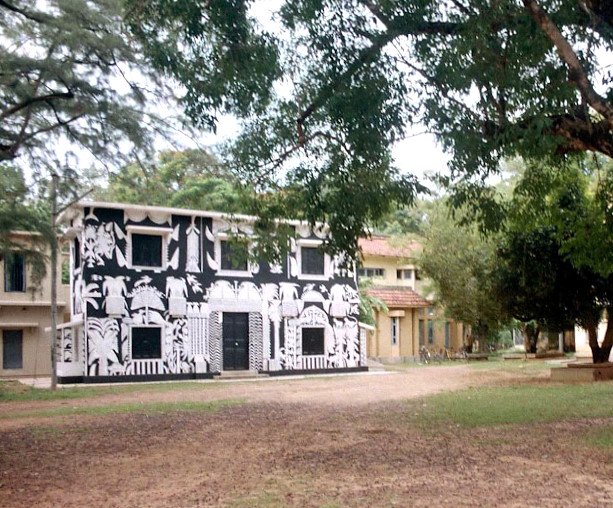
Santiniketan connected art, environment and international exchange in an alternative to conventional colonial education.
Background
Education shaped by place and encounter
Rabindranath Tagore developed a residential school at Santiniketan in 1901. Learning was conceived in relation to nature, art and exchange across cultures. The project responded to the constraints of colonial education without reducing cultural renewal to isolation from the wider world.[2]
What happened
- 1919
Kala Bhavana established
The art school preceded the formal establishment of Visva-Bharati as a university. Teachers including Nandalal Bose helped shape its practice. Students worked across painting, sculpture, design and other forms rather than treating art solely as the replication of an imported academic model.[3]
Impact & evidence
Art beyond a classroom
Murals, sculpture, buildings and open spaces connected visual practice with daily life. Regional crafts and Asian artistic traditions informed experimentation. The result was a distinctive contribution to modern art, not simply a revival of a fixed and unchanging past.[2]
Aftermath & legacy
A collective legacy
Benodebehari Mukherjee, Ramkinkar Baij and successive teachers and students extended the institution's influence. Tagore's founding vision matters, but the school's history is also one of collaboration and difference. Its significance lies in the relationship between education, making and environment that generations continued to develop.[3]
Sources & image credits (3)
- Wikipedia — Kala Bhavana ↗
- UNESCO: Santiniketan ↗
- Visva-Bharati: annual report and Kala Bhavana's history ↗
Saptarshi Sanyal Image source ↗