The creation and promulgation of Hangul
Introducing an alphabet designed for the Korean language.
- When
- 1443–1446
- Where
- Korea
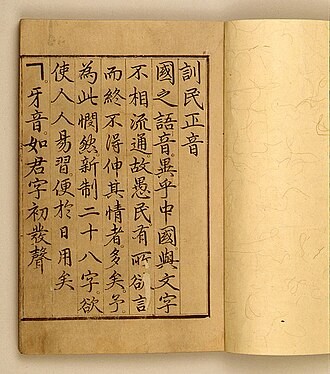
King Sejong's alphabet provided a new means of writing Korean. The surviving Hunminjeongum manuscript records its promulgation and explanations by scholars, preserving both the script and the reasoning used to describe it.
Background
Writing and language
Written Chinese held an important place in Korean learned culture. A script designed for Korean offered a different relationship between spoken language and writing.[1]
What happened
Impact & evidence
An alphabet accompanied by an explanation
The Hunminjeongum manuscript records King Sejong’s promulgation of the new alphabet in 1446, following its completion in 1443. The surviving document is evidence of a deliberate effort to create a writing system suited to Korean speech. An accessible script could reduce a barrier between spoken language and writing, although its creation did not instantly make education equally available to everyone.[1]
Aftermath & legacy
A durable cultural foundation
Hangul became central to Korean literacy and identity. Its documented creation makes the surviving manuscript an unusually direct record of a writing system's introduction.[1]
Sources & image credits (1)
Sejong the Great of Joseon; Public domain; via Wikimedia Commons. Image source ↗