Publication of Newton's Principia
A mathematical account connecting motion on Earth with the movements of planets.
- When
- 1687
- Where
- Cambridge and London, England
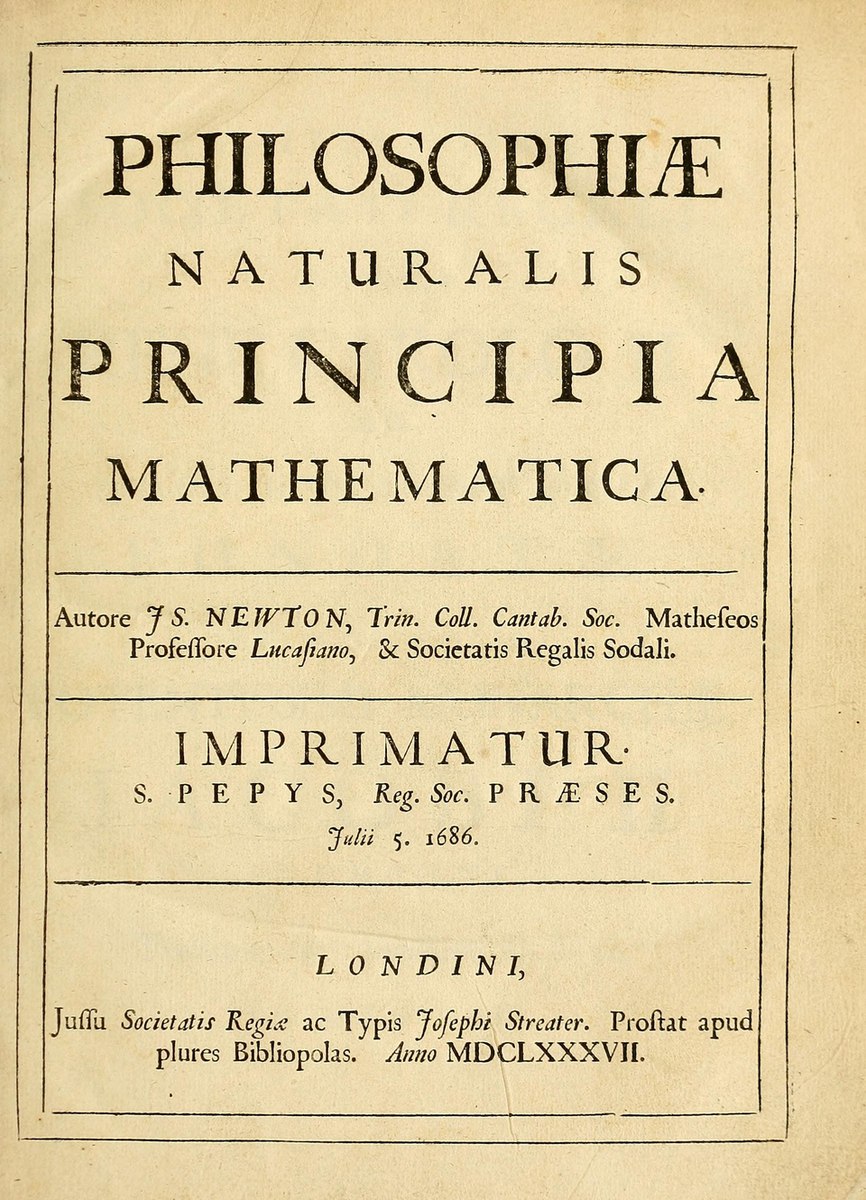
A mathematical account connecting motion on Earth with the movements of planets.
Background
A problem shared by astronomers
Isaac Newton's work grew from questions about the forces governing planetary orbits. Edmond Halley's visit in 1684 encouraged Newton to develop an earlier mathematical argument into a much larger book. Publication depended on correspondence, encouragement and practical assistance as well as individual research.[3]
What happened
- 1687
Three books brought together
The Principia presented laws of motion and universal gravitation through mathematical propositions. Its ambition was to explain terrestrial and celestial phenomena within a common framework, rather than assign separate rules to falling objects and orbiting planets.[2]
Impact & evidence
Prediction became a test of explanation
The book linked geometrical reasoning with observations of the solar system. Its importance lay in the relationships it established among forces, masses and changing motion, not simply in naming gravity. Readers faced a demanding mathematical text whose arguments required interpretation and debate.[2]
Aftermath & legacy
A work revised rather than frozen
The 1687 publication secured Newton's reputation, but did not instantly end disagreement. Subsequent editions and further work by other mathematicians developed its reach. The surviving manuscripts and printed copies show scientific knowledge being argued over, corrected and disseminated.[3]
Sources & image credits (3)
- Wikipedia — Philosophiæ Naturalis Principia Mathematica ↗
- Library of Congress: Principia ↗
- Cambridge University Library: gravity and glory ↗
The original uploader was Zhaladshar at English Wikisource . · Public domain Image source ↗