The first detection of gravitational waves
Measuring ripples in spacetime from two merging black holes.
- When
- 2015–2016
- Where
- LIGO observatories, United States
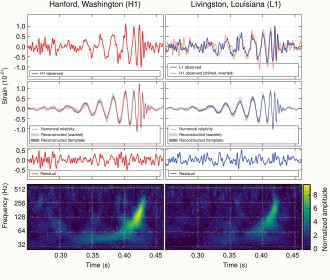
LIGO's two observatories recorded a matching signal from a distant black-hole merger. The observation provided direct evidence of gravitational waves and opened an observational approach to objects and events that cannot be understood through light alone.
Background
Listening through measurement
The observatories use laser interferometers to detect extremely small changes in distance. Agreement between instruments was crucial to separating a cosmic signal from local interference.[1]
What happened
Impact & evidence
Two instruments heard the same event
On 14 September 2015, detectors in Louisiana and Washington recorded the brief signal of two black holes merging. Comparing independently located instruments helped distinguish an astronomical event from disturbances near one detector. The analysis inferred black holes of roughly 29 and 36 solar masses, merging about 1.3 billion years earlier. The public announcement followed in February 2016 after months of checking.[2]
Aftermath & legacy
A new observational field
The discovery established gravitational-wave astronomy. It depended on decades of instrument development and a large scientific collaboration, rather than a single observer.[1]
A new kind of observation
Gravitational waves carry information about the movement of mass rather than arriving as light. Detecting them made it possible to study systems that need not produce a bright optical signal. The result was both a test of general relativity and the beginning of an observational field built around exceptionally small changes in distance.[1]
Sources & image credits (2)
B. P. Abbott et al. (LIGO Scientific Collaboration and Virgo Collaboration) — full list at the end of the article; CC BY 3.0; via Wikimedia Commons. Image source ↗