Proof of Fermat's Last Theorem
Andrew Wiles, with a crucial repair developed with Richard Taylor, resolved a problem posed more than three centuries earlier.
- When
- 1994–1995
- Where
- International mathematics; work led at Princeton
Andrew Wiles, with a crucial repair developed with Richard Taylor, resolved a problem posed more than three centuries earlier.
Background
A simple statement, an extraordinary obstacle
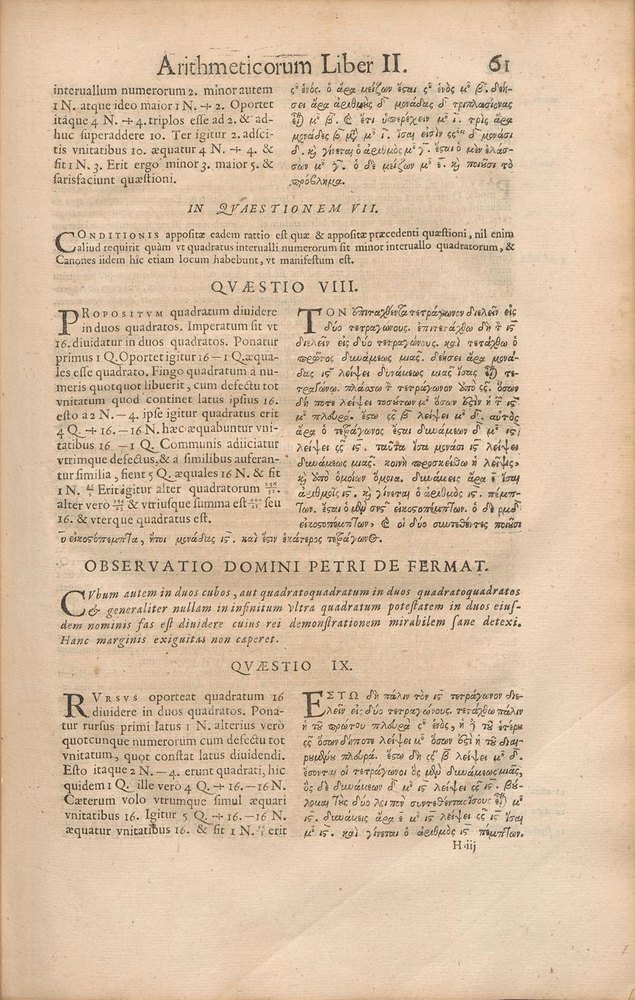
Fermat's Last Theorem says there are no positive whole-number solutions to aⁿ + bⁿ = cⁿ when the integer n is greater than two. Fermat recorded the claim in the seventeenth century, but no general proof by him is known. Many special cases were established over subsequent centuries.[1]
What happened
- 1993–1994
Announcement, gap and repair
Wiles announced a proof in 1993, but scrutiny revealed a gap. Work with Richard Taylor repaired the argument in 1994. The correction was essential: an impressive near-complete argument was not yet a proof of the theorem.[2]
- 1995
Two papers establish the result
The completed work appeared in the Annals of Mathematics. Wiles proved the needed modularity result for semistable elliptic curves, and the accompanying Taylor–Wiles paper supplied a central part of the method. Earlier work by Frey and Ribet connected that result to Fermat's claim.[3]
Impact & evidence
A bridge between mathematical worlds
The achievement advanced connections between elliptic curves and modular forms. Its methods mattered beyond the original equation and helped open further research in number theory. The proof depended on modern mathematics that did not exist in Fermat's lifetime.[2]
Aftermath & legacy
Verification is part of discovery
The gap and its repair show why mathematical claims require detailed checking. The final result was celebrated not because an announcement was persuasive, but because an argument survived expert examination and publication.[3]
Sources & image credits (3)
- Wikipedia — Fermat's Last Theorem ↗
- Abel Prize: Andrew Wiles, 2016 ↗
- University of Toronto: the published proof ↗
Creator not identified in source Image source ↗