Progressive Artists' Group in Bombay
The Progressive Artists' Group sought new artistic directions at the moment of Indian independence.
- When
- 1947–1950s
- Where
- Bombay, India
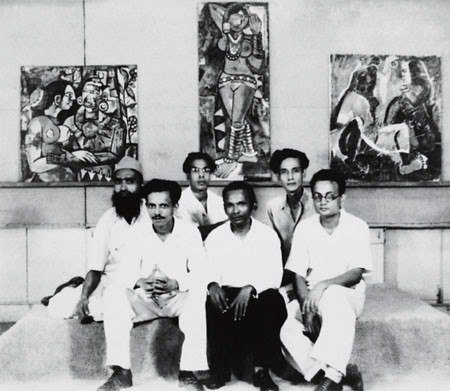
The Progressive Artists' Group sought new artistic directions at the moment of Indian independence.
Background
Independence and partition
The group emerged amid political freedom, partition and the upheaval of urban life. Its artists wanted room for individual experimentation beyond both colonial academic painting and a single prescribed national style.[1]
What happened
- December 1947
A group formed in Bombay
Founding members included F. N. Souza, S. H. Raza, M. F. Husain, K. H. Ara, H. A. Gade and S. K. Bakre. They brought different backgrounds and practices to a collective platform for exhibiting and arguing about modern art.[2]
Impact & evidence
International forms, local experience
Members engaged with modernist approaches while painting subjects and experiences connected to India. Their work did not follow one uniform visual formula. The group's significance lay partly in making stylistic freedom itself an important position.[1]
Aftermath & legacy
A short-lived organisation with a long legacy
Members moved abroad or pursued separate careers, and the formal group did not last indefinitely. Its name nevertheless became central to accounts of post-independence Indian art. The artists retained distinct styles, and their achievements formed part of a larger post-independence artistic community.[1]
Sources & image credits (2)
- Wikipedia — Bombay Progressive Artists' Group ↗
- Asian Art Resource Room: establishment of the Progressive Artists' Group ↗
Unknown author Unknown author · Public domain Image source ↗