Oppau chemical plant explosion
A fertiliser-storage explosion killing more than 500 people and destroying much of a surrounding community.
- When
- 21 September 1921
- Where
- Oppau, Germany
A fertiliser-storage explosion killing more than 500 people and destroying much of a surrounding community. BASF's Oppau plant produced nitrogen fertiliser. Stored ammonium sulfate nitrate could compact into a hard mass, and workers used small explosive charges to loosen it.
Background
Fertiliser that had hardened in storage
BASF's Oppau plant produced nitrogen fertiliser. Stored ammonium sulfate nitrate could compact into a hard mass, and workers used small explosive charges to loosen it. Previous use of the technique encouraged confidence, but repeated survival of a practice did not establish that every stored mixture was safe.[1]
What happened
- 21 September 1921
A routine operation becomes catastrophic
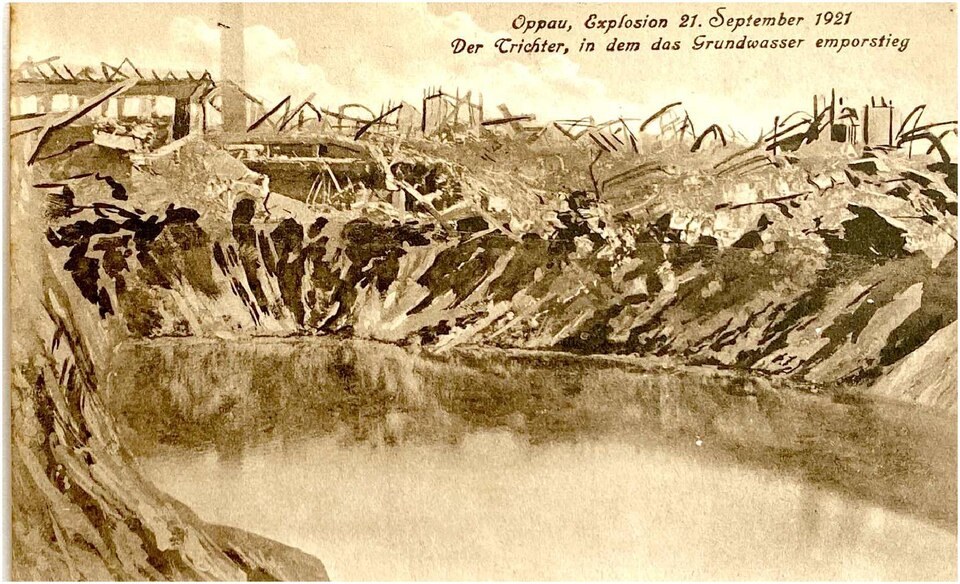
A loosening blast initiated a much larger explosion in the stored material. The force devastated the plant and surrounding buildings. The scale of the release transformed an internal industrial operation into a disaster affecting workers and residents beyond the factory boundary.[1]
- After the explosion
Rescue and interruption of production
Emergency efforts confronted collapsed buildings and large numbers of injured people. BASF stopped production of the affected fertiliser and did not resume it until 1940 using a modified process. Investigation had to address both material behaviour and the assumptions behind the operating method.[1]
Impact & evidence
Historical totals vary slightly
BASF's historical account states that over 500 lives were lost; common published totals are around 560. Approximately 2,000 people were injured. These figures convey the scale without implying that small differences between historical counts can be resolved with certainty.[2]
Aftermath & legacy
Routine does not mean safe
Oppau became an enduring warning about reactive materials and changing process conditions. A procedure may appear reliable until composition, moisture or other circumstances change. The disaster's lesson concerns systematic testing and hazard control, rather than attributing an industrial catastrophe solely to the last worker involved.[1]
Sources & image credits (2)
Pgmpjl · CC BY-SA 4.0 (source record). Resized for display. Image source ↗