Noether's theorem connecting symmetry and conservation
Noether connected continuous symmetries of physical laws with conserved quantities.
- When
- 1918
- Where
- Göttingen, Germany
Noether connected continuous symmetries of physical laws with conserved quantities.
Background
A problem at the meeting of physics and mathematics
Work on relativity raised difficult questions about invariance and conservation. Emmy Noether brought the methods of abstract mathematics to these problems while facing institutional barriers as a woman in German academic life. Her contribution was not merely a convenient reformulation of a familiar rule.[1]
What happened
- 1918
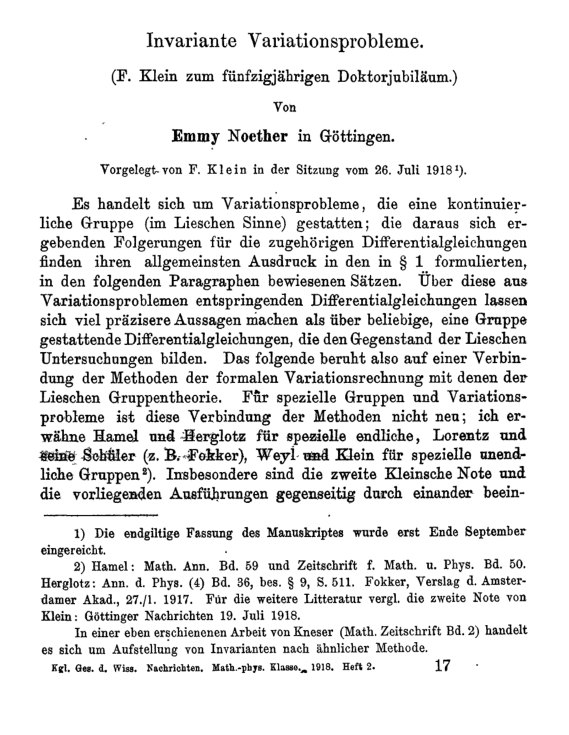
Invariant Variational Problems
Noether published her results in a paper on invariant variational problems. The work established relationships between symmetries of an action and conservation laws, and also treated the more complex identities associated with continuously variable local symmetries.[2]
Impact & evidence
Time symmetry and energy
When a suitable physical system's action is unchanged by shifting the time origin, a corresponding conservation law follows. Spatial translation similarly relates to momentum. These examples explain the theorem's importance, but its assumptions matter: not every superficially symmetric situation automatically has a conserved quantity of the same form.[1]
Aftermath & legacy
A foundation for modern theoretical physics
Noether's results became central to classical mechanics and field theory. They made symmetry a way to discover and organise physical laws rather than simply admire their elegance. Her 1918 work remains distinct from, while connected to, her major contributions to abstract algebra.[1]
Sources & image credits (2)
Emmy Noether Image source ↗