Nanjing massacre
Imperial Japanese forces committing mass murder and sexual violence after capturing Nanjing.
- When
- December 1937–early 1938
- Where
- Nanjing, China
Imperial Japanese forces committing mass murder and sexual violence after capturing Nanjing. Japan's invasion expanded during 1937, and fighting at Shanghai preceded the advance on the Chinese capital. As Nanjing's defence collapsed, civilians and disarmed soldiers remained vulnerable.
Background
War reaches the capital
Japan's invasion expanded during 1937, and fighting at Shanghai preceded the advance on the Chinese capital. As Nanjing's defence collapsed, civilians and disarmed soldiers remained vulnerable. Capture of the city did not end violence: it began a period of killings, rape, looting and destruction directed at people no longer participating in combat.[1]
What happened
- December 1937
Prisoners and civilians targeted
Japanese troops carried out large-scale executions of captured or disarmed Chinese soldiers and killed civilians in the city and surrounding area. Attempts to identify former soldiers also exposed ordinary residents to arbitrary detention and killing. The absence of an effective civilian protection system intensified the danger.[1]
- Winter 1937–1938
A safety zone amid widespread violence
Foreign residents and Chinese workers maintained a civilian safety zone and recorded atrocities. Their reports, photographs and diaries became important evidence, but the zone could not provide complete protection. Sexual violence caused deaths, injuries and lasting trauma that cannot be represented by a death toll alone.[1]
Impact & evidence
Boundaries affect the count
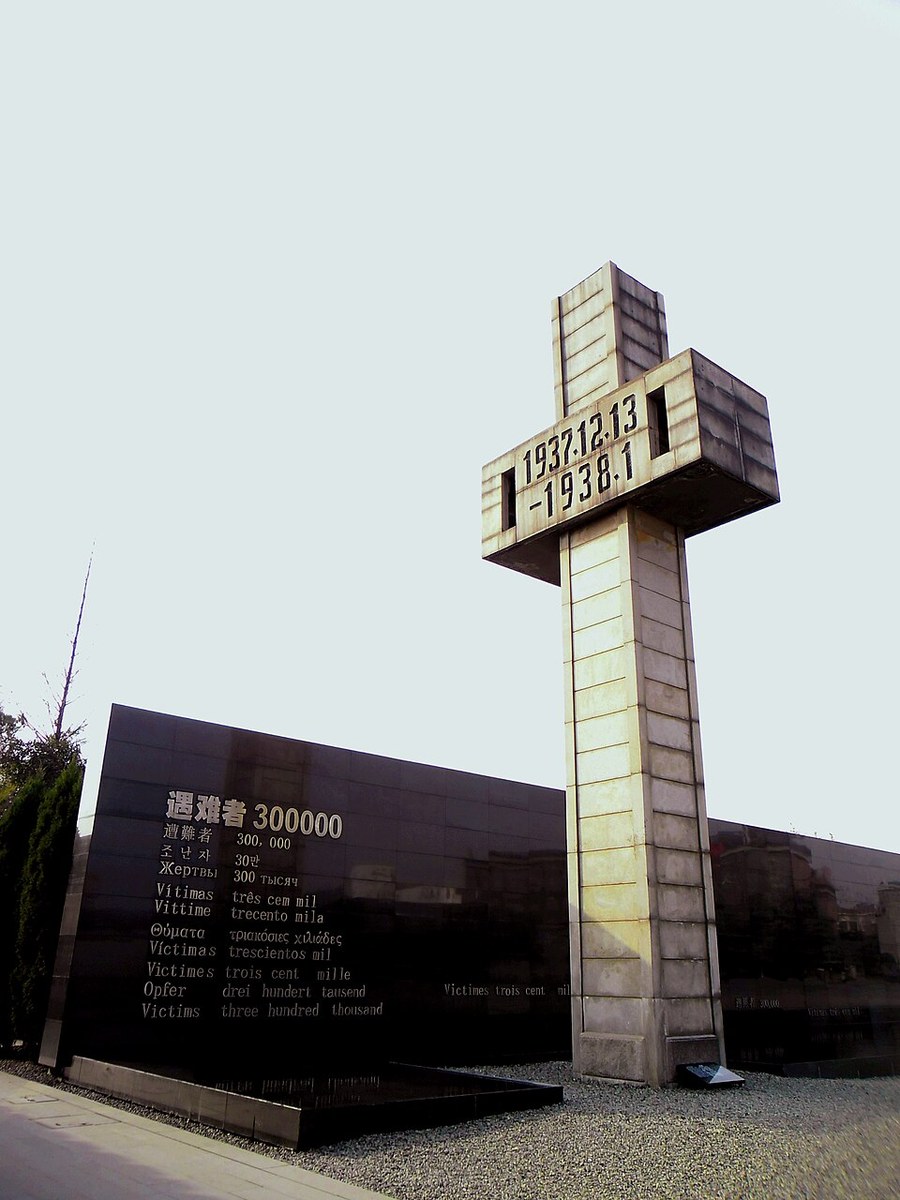
Common published estimates use a range of 200,000–300,000 victims; other historians adopt different city boundaries, time periods or definitions and reach different totals. China's official commemorative figure is 300,000. Explaining those differences is essential, rather than presenting one number as an exact census or treating uncertainty as evidence that the massacre did not occur.[2]
Aftermath & legacy
Evidence and public memory
Postwar trials considered the atrocities, while survivors and documentary collections preserved evidence of the killings. Nanjing remains a major subject of remembrance and diplomatic dispute. A careful account distinguishes debate about numerical scope from the extensive evidence of mass murder and sexual violence.[1]
Sources & image credits (2)
董辰兴 · CC BY-SA 4.0 (source record). Resized for display. Image source ↗