Mullivaikkal and civilian atrocities at the end of Sri Lanka's war
Mass civilian deaths during the final offensive of Sri Lanka’s civil war.
- When
- January–May 2009
- Where
- Vanni and Mullivaikkal, Sri Lanka
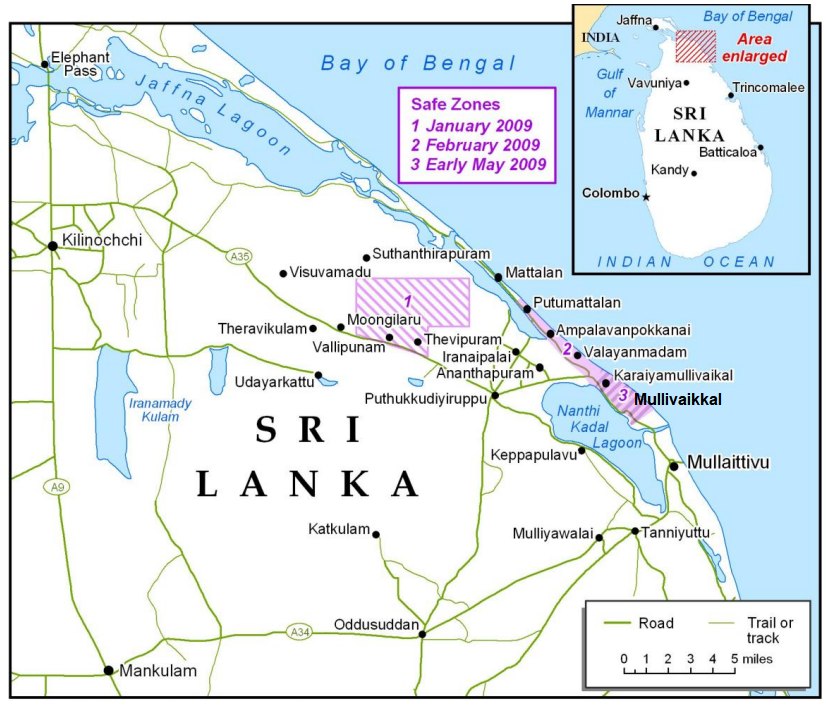
Mass civilian deaths during the final offensive of Sri Lanka’s civil war.
Background
Civilians in a shrinking enclave
As Sri Lankan forces advanced through the Vanni, a predominantly Tamil civilian population repeatedly fled into territory still held by the LTTE. By the closing weeks, families were concentrated along a narrow coastal strip near Mullivaikkal. Food, medicine, shelter and functioning medical facilities became increasingly scarce.[1]
What happened
- 2009
Areas designated for civilian protection were shelled
The UN investigation examined repeated shelling of densely populated areas, hospitals and humanitarian facilities. Government declarations of “no-fire zones” did not make those areas safe. Investigators also documented LTTE restrictions on civilian movement, forced recruitment and shootings of people attempting to escape. These were separate violations against the same trapped population.[2]
- May 2009
Military victory and its human aftermath
The offensive ended with the destruction of the LTTE’s territorial forces and leadership. Survivors emerged injured, bereaved and separated from relatives. Screening and detention followed; accounts of people disappearing after surrender became a central part of the subsequent demand for accountability.[1]
Impact & evidence
The death toll is an estimate, not a census
The UN panel’s assessment, summarised by Human Rights Watch, indicated that up to 40,000 civilians could have died during the final phase. This is not a verified count of deaths on one beach or one day. The absence of a comprehensive accounting leaves the precise toll unresolved; missing-person and population-discrepancy figures cannot simply be added as confirmed deaths.[4]
Aftermath & legacy
Remembrance and genocide recognition
In May 2022, Canada’s House of Commons unanimously recognised the genocide of Tamils in Sri Lanka and designated 18 May as Tamil Genocide Remembrance Day. That parliamentary recognition is distinct from the UN’s investigative findings and from a criminal court judgment. Survivors and relatives continue to seek the fate of the missing, identification of remains and accountability.[3]
Sources & image credits (4)
- Wikipedia — Mullivaikkal massacre ↗
- OHCHR investigation on Sri Lanka, 2015 ↗
- Canadian House of Commons resolution, 18 May 2022 ↗
- Human Rights Watch: UN accountability report, 2011 ↗
U.S. Department of State · Public domain Image source ↗