Kerala school's infinite series
Mathematicians in Kerala developed infinite series for trigonometric functions and calculations of pi.
- When
- Fourteenth–sixteenth centuries
- Where
- Kerala, southwestern India
Mathematicians in Kerala developed infinite series for trigonometric functions and calculations of pi.
Background
Astronomy drove mathematical work
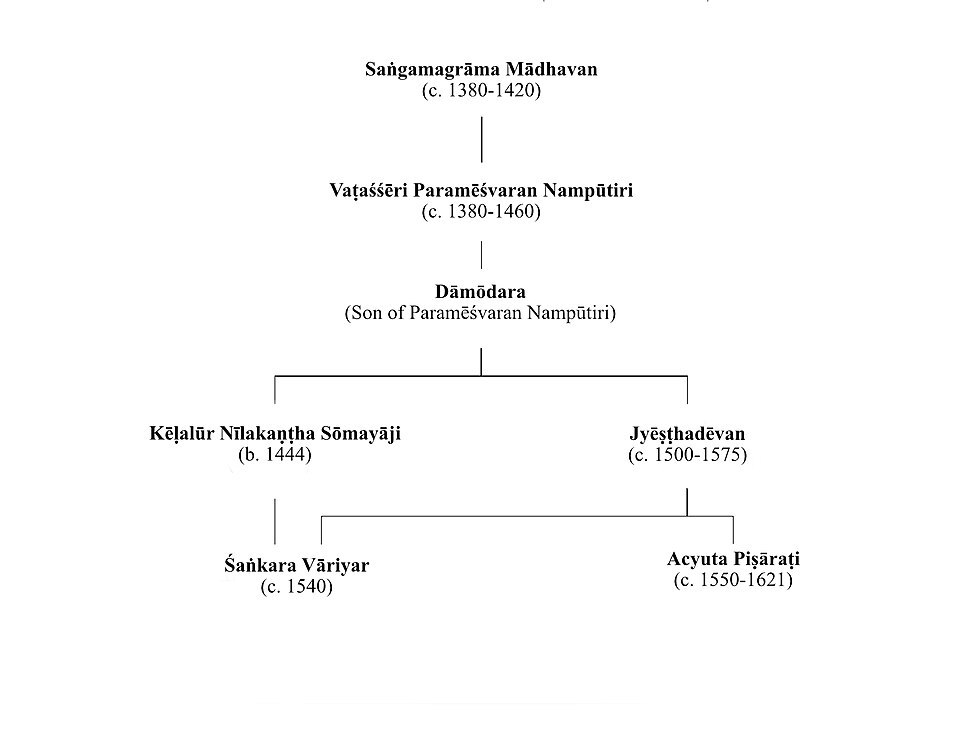
Madhava of Sangamagrama is associated with a tradition of mathematical astronomy in Kerala. Later scholars preserved and developed results attributed to him. Much of the evidence therefore comes through successors rather than a complete surviving collection of his own mathematical writings.[2]
What happened
- Fourteenth–sixteenth centuries
Finite calculations from infinite processes
The tradition developed series related to sine, cosine and arctangent, including ways to improve approximations to pi. Correction terms helped obtain useful numerical accuracy without summing an unlimited number of terms.[2]
Impact & evidence
An achievement requiring its own context
These results preceded comparable European series by centuries. They deserve explanation as specific mathematical developments, rather than being mentioned only as a footnote to European calculus. Their existence does not by itself establish a documented route of transmission to Newton or Leibniz.[3]
Aftermath & legacy
Preservation and interpretation
Later works, including the Yuktibhasa, provide evidence of reasoning within this tradition. Historians distinguish infinite-series techniques from the full later framework of differential and integral calculus. Both the achievements and the limits of surviving evidence matter when assigning priority.[3]
A delayed reception
Charles Whish’s 1834 paper drew European attention to the Kerala texts, but their significance received little sustained attention until the twentieth century. K. Ramasubramanian’s history traces the surviving arguments in later works, including Yuktibhasa, whose explanations show how results were reasoned through and transmitted beyond Madhava’s lifetime.[3]
Sources & image credits (3)
- Wikipedia — Kerala school of astronomy and mathematics ↗
- University of St Andrews: Madhava ↗
- European Mathematical Society: history and historiography of calculus in India ↗
ChandlerMinh · CC BY-SA 4.0 Image source ↗