Ibn al-Haytham's Book of Optics
An experimental and mathematical account of vision based on light entering the eye.
- When
- Early 11th century
- Where
- Medieval Islamic world
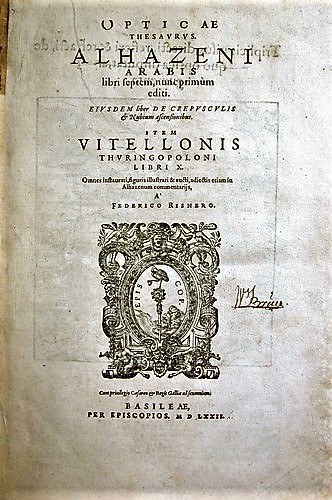
An experimental and mathematical account of vision based on light entering the eye. Earlier theories differed over whether vision depended on rays emitted by the eyes or something received from objects. Ibn al-Haytham examined light, the structure of the eye and visual perception together.
Background
Competing explanations of sight
Earlier theories differed over whether vision depended on rays emitted by the eyes or something received from objects. Ibn al-Haytham examined light, the structure of the eye and visual perception together. His Book of Optics combined inherited mathematical learning with deliberate investigation rather than accepting one older authority unchanged.[1]
What happened
- Early 11th century
Experiments with light
The work studied reflection, refraction and the paths of light through controlled arrangements. Darkened spaces and apertures helped examine how light travelled. Geometry supplied a way to explain the results, while observation constrained what a plausible account of vision could claim.[1]
- From object to perception
Seeing requires received light
Ibn al-Haytham argued that light from objects enters the eye. He also recognised that perception involves interpretation, not simply a mechanical image. His anatomical and physical explanations were not identical to modern optics, but they substantially changed the questions and methods used to study sight.[1]
Impact & evidence
Evidence and reasoning together
The achievement was not a single isolated experiment. It was the systematic connection of repeatable investigation, mathematical argument and criticism of inherited claims. Describing him simply as the inventor of a camera or of all scientific method compresses a richer and more historically specific contribution.[2]
Aftermath & legacy
Translation and later influence
Latin translation carried the work into European scholarship, where it influenced later studies of vision and light. That transmission shows scientific development as an exchange across languages and centuries. The text remains important both for its conclusions and for the way it made optical problems open to disciplined investigation.[1]
Sources & image credits (2)
Ibn al-Haytham, Vitello, Friedrich Risner · Public domain (source record). Resized for display. Image source ↗