The Holodomor
Mass starvation under Stalinist grain requisition and repression in Ukraine.
- When
- 1932–1933
- Where
- Soviet Ukraine
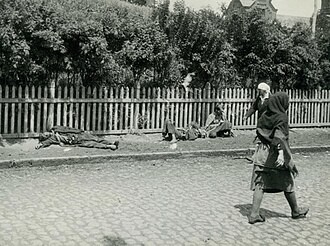
The Holodomor was the catastrophic famine in Soviet Ukraine in 1932–1933. Demographic research used by Harvard’s MAPA project estimates approximately 3.9 million excess deaths in Ukraine over 1932–1934. Stalinist food confiscation, punitive measures and restrictions on movement intensified mass starvation. The figure concerns Ukraine, not the whole Soviet famine.
Background
Collectivisation and grain demands
Stalin’s government forced agricultural collectivisation and imposed grain procurement targets. Research links sharply increased 1931 quotas in parts of Kyiv, Kharkiv and Vinnytsia to shortages before the worst mortality.[3]
Why a harvest crisis became mass starvation
Forced collectivisation transferred control over agricultural production to a coercive state system. Requisitions could leave households without food or seed, while punitive searches removed reserves. Families facing hunger could not freely escape when the authorities restricted movement. These measures made the actions of the Soviet state central to explaining the famine, rather than treating deaths as the automatic consequence of a poor harvest.[1]
What happened
- 1932
Food seizures and blacklisting
Authorities punished failure to fulfil quotas by blacklisting communities, banning trade and confiscating food and other goods. Requisitions extended beyond grain to household food reserves.[3]
- January–June 1933
Escape restricted; deaths peak
Soviet authorities restricted movement out of Ukraine in January 1933. The MAPA research summary places about 85% of Ukraine’s estimated famine deaths in the first six months of that year.[3]
Impact & evidence
Estimated deaths: approximately 3.9 million
Demographers reconstruct population records to estimate deaths above the number expected without famine. This is an estimate of excess mortality in Soviet Ukraine, not a count of registered starvation deaths or a total for the entire USSR. Different methods and geographic boundaries produce different estimates.[2]
Documents and survivor testimony
State records and survivors’ accounts document food confiscation, repression and hunger. These sources complement demographic reconstruction rather than supplying a complete register of every victim.[1]
Aftermath & legacy
Suppression, remembrance and recognition
Soviet suppression hindered public acknowledgment. Ukraine commemorates the Holodomor as genocide; historical and demographic research continues to examine state intent, responsibility and the distribution of deaths.[1]
Counting the dead after suppression
The famine left both a demographic rupture and a damaged record. Researchers compare censuses, birth and death registrations, and migration estimates to reconstruct losses. Harvard’s MAPA project maps mortality across districts, showing that the experience was geographically uneven. Its estimate of excess deaths is separate from the deficit of births caused by the crisis; adding the two produces a different measure of population loss.[2]
Sources & image credits (3)
- National Museum of the Holodomor-Genocide — History ↗
- Harvard MAPA — Demographic research and estimates ↗
- Harvard Ukrainian Research Institute — Famine mortality and state measures ↗
Alexander Wienerberger; Public domain; via Wikimedia Commons. Image source ↗