Dalton's atomic theory
Dalton used atoms and relative weights to explain why substances combine in regular proportions.
- When
- 1803–1808 and later refinement
- Where
- Manchester, England
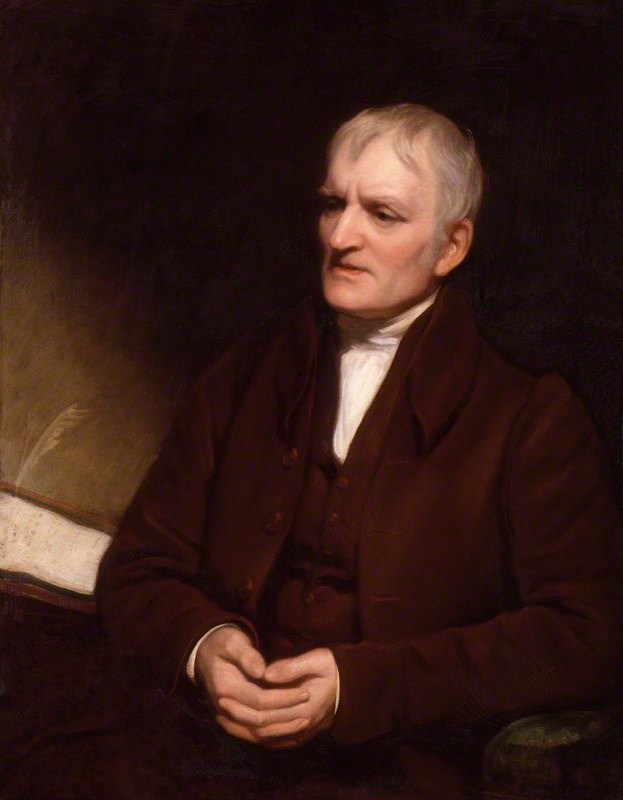
Dalton used atoms and relative weights to explain why substances combine in regular proportions.
Background
From gases to chemical explanation
John Dalton's work on gases and meteorology helped lead him toward an atomic account of matter. Ancient atomism had proposed indivisible particles, but Dalton connected atoms to measurable chemical relationships. That made the theory useful for explaining experiments rather than remaining only a philosophical position.[2]
What happened
- 1803–1808
A theory takes public form
Dalton discussed atomic ideas before publishing the first volume of A New System of Chemical Philosophy in 1808. He represented elements with symbols and assigned relative atomic weights. Compounds were understood through combinations of atoms in simple numerical ratios.[3]
Impact & evidence
Some formulas and weights were wrong
Dalton lacked a reliable way to determine every molecular composition. Assumptions about simple combinations produced errors, including an incorrect formula for water. The historical achievement does not require treating his complete system as modern chemistry already finished.[2]
Aftermath & legacy
A framework that could be corrected
Later work clarified atoms, molecules and atomic weights. Dalton's theory nevertheless helped turn chemical composition into a quantitative science. Its development illustrates how a productive explanatory model can be transformative while still containing assumptions that subsequent evidence overturns.[3]
Sources & image credits (3)
- Wikipedia — John Dalton ↗
- Science History Institute: John Dalton ↗
- Science History Institute: Dalton and the scientific method ↗
Thomas Phillips Image source ↗