Congo Free State rubber regime
Colonial rubber extraction enforced through coercion and violence under Leopold II.
- When
- 1885–1908
- Where
- Congo Free State, present-day Democratic Republic of the Congo
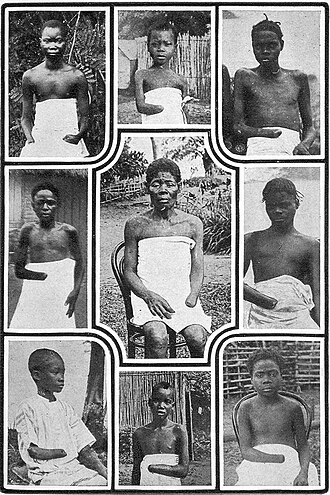
The Congo Free State was ruled by Belgium's King Leopold II as a separate colonial possession. Rubber extraction relied on forced labour and brutal enforcement. Reports of abuses generated an international campaign and an inquiry that challenged the regime's claims of benevolent rule.
Background
Private colonial rule
Established in 1885, the state placed a vast territory under Leopold's authority. European officials and the Force Publique enforced colonial demands on communities whose labour supplied rubber.[1]
What happened
- 1890s
Quotas and punishment
Witnesses described corporal punishment for failure to deliver rubber quotas. Daniel Bersot, a Swiss colonial administrator in 1897–98, later criticised the system while retaining racial prejudices of his own.[1]
- 1904–1905
An official inquiry
A commission investigated allegations associated with Roger Casement and E. D. Morel. Its report, published in 1905, documented abuses against African communities and recommended changes.[2]
- 1908
Belgian annexation
The Congo Free State became the Belgian Congo. The change ended Leopold's personal regime but did not end colonial rule.[3]
Impact & evidence
The commission's report
The report is an important official acknowledgment of violence, but its institutional origins matter: it was produced within the colonial system it investigated.[2]
Reading a population catastrophe
Violent coercion disrupted communities as well as injuring individual workers. A death toll for a particular raid, a regional population decline and an estimate for the entire period answer different questions. The records cited here document the rubber regime and its abuses but do not provide a complete, verifiable national count of deaths. An exact total would imply a precision the evidence does not support.[2]
Aftermath & legacy
Reading colonial witnesses critically
Accounts include criticism, justification and outright propaganda. The Swiss National Museum contrasts officials who condemned punishment with others who defended the regime, showing why colonial testimony requires comparison.[1]
Wealth displayed in Belgium
The AfricaMuseum traces its own origins to Leopold II’s 1897 colonial exhibition at Tervuren. Congolese people were displayed in a recreated village, and seven died. The institution explicitly describes the exhibition as propaganda intended to win investors and Belgian public support. Profits from the royal domain helped finance building projects in Belgium, linking the regime’s extraction to the monumental image it presented abroad.[3]
Sources & image credits (3)
- Swiss National Museum — Colonial entanglements, Experts section ↗
- AfricaMuseum — Commission d'Enquête ↗
- AfricaMuseum — Museum history ↗
unknown, please edit with correct data.; Public domain; via Wikimedia Commons. Image source ↗