Cantor's theory of infinite sets
Cantor demonstrated different sizes of infinity and made infinite collections objects of mathematical study.
- When
- 1870s–1890s
- Where
- Germany and international mathematics
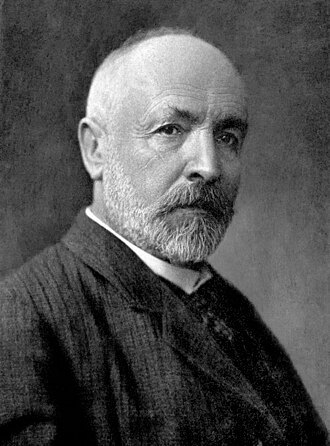
Cantor demonstrated different sizes of infinity and made infinite collections objects of mathematical study.
Background
Infinity becomes a precise question
Work on analysis and trigonometric series led Georg Cantor to investigate sets of numbers. Comparing infinite collections required a method other than ordinary finite counting. Matching elements one to one provided a way to ask whether two infinite sets had the same size.[2]
What happened
- 1874
Not all infinities are equal
Cantor showed that the real numbers cannot be listed in the same way as the natural numbers. This distinguished countable from uncountable infinity. The result challenged the idea that infinity was a single undifferentiated quantity.[2]
- 1891–1897
Diagonal arguments and transfinite numbers
Further work developed a powerful diagonal method and theories of cardinal and ordinal numbers. Cardinals describe size, while ordinals describe order. Keeping that distinction clear is essential: two sets can have the same size while supporting different order structures.[1]
Impact & evidence
Sets reshape analysis
Set theory provided tools for describing number systems and mathematical structures with greater precision. The work provoked opposition and philosophical debate, but its usefulness made it increasingly difficult for mathematics to avoid questions about infinite collections.[2]
Aftermath & legacy
Foundations remained a collective problem
Paradoxes in unrestricted set formation led later mathematicians to formulate axiomatic systems. Cantor's work did not settle every foundational question, including the continuum hypothesis. It opened a field whose unresolved problems became as influential as its early theorems.[1]
Sources & image credits (2)
Unknown author Image source ↗