Bodo League massacres
South Korean forces executed alleged leftists and members of the Bodo League during the Korean War.
- When
- Summer 1950
- Where
- South Korea
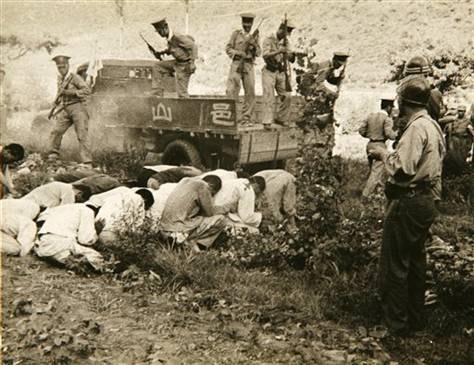
South Korean forces executed alleged leftists and members of the Bodo League during the Korean War.
Background
A register that became a target list
The National Guidance League, or Bodo League, was established in 1949 to bring suspected leftists under state supervision. Enrolment did not reliably establish political commitment: people were also registered through pressure or administrative quotas. Once war began, membership became grounds for detention and lethal suspicion.[1]
What happened
- June–August 1950
Detention followed by killing
After North Korea's invasion, South Korean police and military personnel rounded up league members and prisoners. The commission's Jinju account describes people responding to summons without knowing the danger, while others were forcibly taken. Executions occurred in numerous localities as the front moved south.[2]
Impact & evidence
At least 100,000 in one investigator's estimate
Commissioner Kim Dong-choon estimated that at least 100,000 people were executed in the 1950 civilian killing campaign. This is an estimate of a broader pattern, not a completed register of named Bodo League victims. Local investigations establish particular killings; incomplete records prevent a precise nationwide total.[3]
Photographs, graves and testimony
Later investigations combined survivor accounts, exhumations and military records. American records and photographs also challenged the long public silence. These materials require attention to who witnessed, ordered or carried out each killing; alliance with the perpetrators alone does not identify an individual chain of command.[1]
Aftermath & legacy
Families bore the stigma
Relatives lived with suspicion and restrictions while the massacres remained largely absent from public history. Truth-seeking therefore concerned both the dead and surviving families. Official recognition came after decades of campaigning, and must not be confused with comprehensive criminal accountability for every execution site.[3]