Batavia massacre
Dutch East India Company forces and other attackers massacred thousands of Chinese residents in Batavia.
- When
- October 1740
- Where
- Batavia, present-day Jakarta, Indonesia
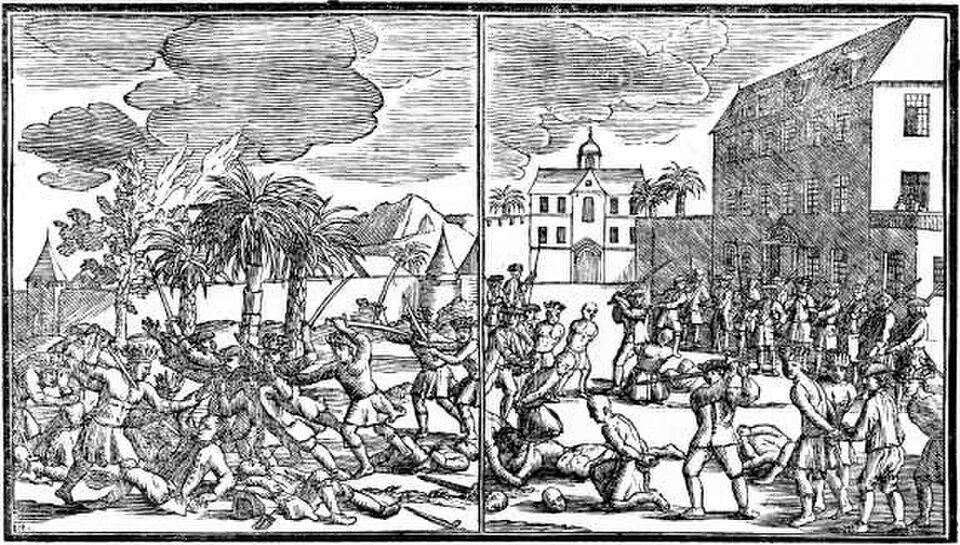
Dutch East India Company forces and other attackers massacred thousands of Chinese residents in Batavia.
Background
Economic insecurity and collective suspicion
Chinese workers and merchants were important to Batavia's economy, including its sugar industry. Economic decline and coercive Dutch measures increased tensions. Plans to deport unemployed Chinese people fed fears and unrest, while colonial authorities increasingly treated an entire community as a security threat.[1]
What happened
- October 1740
Violence inside the city
Following fighting outside Batavia, Dutch forces and other armed attackers turned on Chinese residents within it. Houses were burned and people were killed in streets, homes and institutions. The violence extended to people unable to fight, including prisoners and hospital patients.[1]
Impact & evidence
About 10,000 Chinese residents killed
A commonly cited estimate places the deaths inside Batavia at about 10,000. The figure is approximate and should not be confused with a complete casualty count for subsequent fighting elsewhere in Java. The destruction also displaced survivors and devastated homes and livelihoods.[1]
Accounts shaped by their authors
Blussé compares German eyewitness narratives rather than assuming that all contemporary descriptions are equally reliable. Such records can preserve details missing from official accounts while also containing sensationalism, self-interest or material the writer did not personally witness.[3]
Aftermath & legacy
A city rebuilt through exclusion
Surviving Chinese residents faced tighter segregation and control, even as the colonial economy continued to depend on their work. Later political disputes among Dutch officials did not reverse the massacre's effects. Its history exposes the combination of economic dependence, racialised suspicion and collective punishment at the heart of Company rule.[2]
Sources & image credits (3)
- Wikipedia — 1740 Batavia massacre ↗
- Leiden University Press: A Colonial Tragedy ↗
- Leonard Blussé: German eyewitness accounts of the 1740 massacre ↗
Unknown illustrator. Published in a work attributed to Abraham Van Stolk ( 1814-1896 ) and Gerrit van Rijk ( 1846-1912 ) Image source ↗