Assyrian genocide during the First World War
Mass killing and displacement of Assyrian and Syriac Christian communities.
- When
- First World War and aftermath
- Where
- Southeastern Anatolia and neighbouring Persia
Mass killing and displacement of Assyrian and Syriac Christian communities.
Background
Communities across a war zone
Assyrian and Syriac Christians lived across several provinces and ecclesiastical traditions. Ottoman wartime mobilisation, frontier fighting and hostility toward Christian populations placed these communities in danger; their experiences were not identical across every locality.[1]
What happened
- 1915 onward
Killing, expulsion and flight
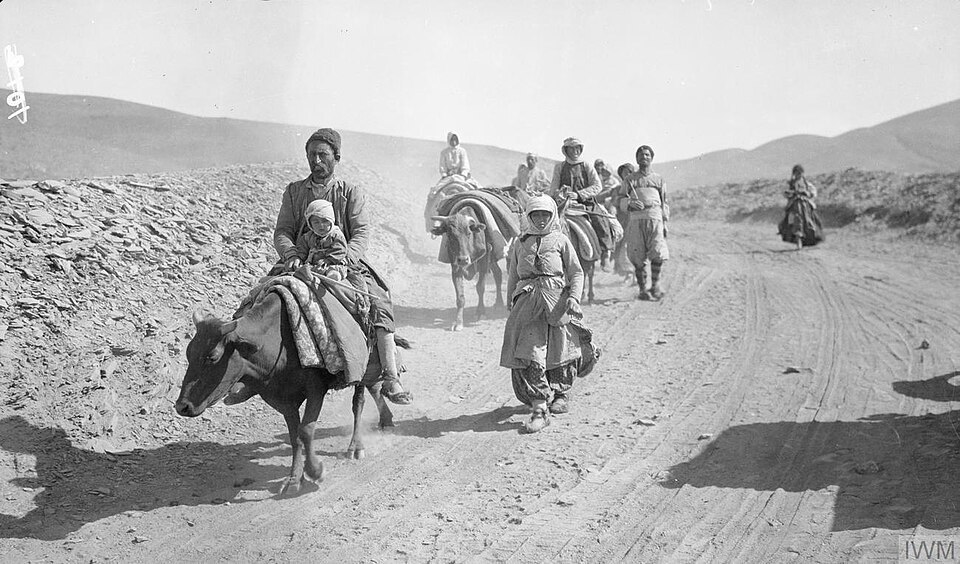
Ottoman forces and allied local actors attacked communities, carried out deportations and destroyed settlements. Some communities resisted or escaped through mountain regions, while refugees faced hunger and further violence across borders.[1]
- 1915–1918
Different regions, related campaigns
Gaunt, Atto and Barthoma distinguish expulsions from Hakkari, Ottoman invasion of the Urmia district in Persia, and attacks on Syriac communities around Diyarbakir. Survivors from Hakkari fled into Iran; renewed warfare in 1918 drove many south toward British-held Iraq, exposing refugees to further attacks during flight.[2]
Impact & evidence
A catastrophe counted across borders
At the 1919 Paris Peace Conference, the Assyro-Chaldean delegation estimated 250,000 losses across the Ottoman Empire and Persia, approximately half the pre-war population it represented. This was a delegation’s estimate, not a complete victim census. Later totals differ with the communities, territory and years included; flight and dispersed settlement further complicated accounting.[1]
Aftermath & legacy
Sayfo and remembrance
The name Sayfo, meaning sword, preserves the catastrophe in community memory. Scholarship and campaigns for recognition have sought to distinguish this genocide’s local histories while recognising its connections to the wider destruction of Ottoman Christian populations.[1]
Sources & image credits (2)
Varges, Ariel · Public domain Image source ↗