Anti-Tamil violence in Sri Lanka
Attacks on Tamil communities following Sri Lanka’s 1977 election.
- When
- August 1977
- Where
- Sri Lanka
Attacks on Tamil communities following Sri Lanka’s 1977 election.
Background
An election amid competing national projects
The United National Party won national power while the Tamil United Liberation Front received a strong mandate in Tamil areas on a platform of separation. Political disagreement did not justify collective violence against Tamil residents, including plantation workers far from the principal centres of separatist organisation.[1]
What happened
- August 1977
Violence spread from local incidents
Confrontations in Jaffna were followed by anti-Tamil attacks elsewhere. Mobs destroyed property and assaulted residents. Accounts describe failures of police protection and the use of political rhetoric to excuse or encourage hostility.[1]
- 1977–1980
A presidential inquiry
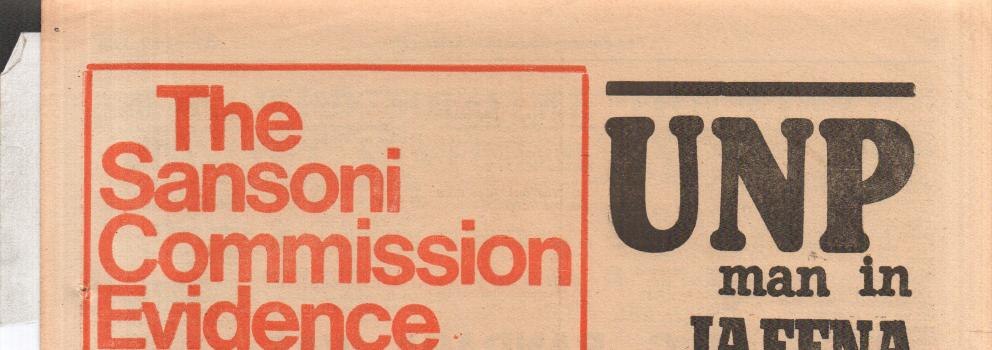
The Sansoni Commission was appointed on 9 November 1977 to investigate incidents between 13 August and 15 September. Its remit included deaths, injuries, destruction and theft, responsibility for the violence, assistance to victims and prevention of recurrence. The resulting official report became an important, contested record of the attacks and the authorities’ response.[3]
Impact & evidence
Deaths and displacement
The official toll was 125; other published estimates put deaths around 300. These are alternative estimates, not separate groups of victims. Many more people lost homes or were forced to move, including Hill Country Tamil families.[1]
Aftermath & legacy
Another rupture
The violence deepened distrust of state protection after the earlier pogroms. It also helped shift Tamil politics away from confidence in parliamentary negotiation. That consequence does not mean every victim supported any particular political party or armed movement.[1]
A pattern of impunity
Human Rights Watch’s retrospective assessment connected recurrent communal violence with the failure to investigate and punish attacks. The political significance of 1977 therefore extended beyond immediate casualties: another generation of families experienced the loss of homes and security without dependable protection or redress.[2]
Sources & image credits (3)
- Wikipedia — 1977 anti-Tamil pogrom ↗
- Human Rights Watch: communal violence and impunity, 1995 ↗
- Sansoni Commission report, 1980: inquiry into the 1977 violence ↗
Noolaham digital archive · Source document; rights retained by publisher Image source ↗