Al-Khwarizmi's algebra
A systematic method for reducing and solving classes of linear and quadratic problems.
- When
- Early ninth century
- Where
- Baghdad, Abbasid Caliphate
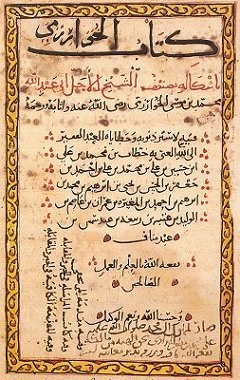
A systematic method for reducing and solving classes of linear and quadratic problems.
Background
Calculation expressed in words
Muhammad ibn Musa al-Khwarizmi wrote in the scholarly environment of Abbasid Baghdad. His algebra treated practical numerical problems through general procedures. The text used verbal descriptions and geometrical demonstrations, rather than the symbolic notation familiar from modern school algebra.[3]
What happened
- Ninth century
Reducing problems to standard forms
The method organised equations into types and showed how to transform them into solvable forms. Completing a square could be represented by arranging areas, making the steps visible as a geometrical argument rather than merely prescribing an answer.[2]
Impact & evidence
A systematic procedure was the innovation
Positive quantities shaped the classification. The presentation differs from modern algebra’s negative roots and symbolic quadratic formula. Its historical importance lies in organising a family of problems into teachable methods with explanations.[3]
Aftermath & legacy
Translation and a lasting vocabulary
Later translations carried the work into Latin mathematical scholarship. The word algebra derives from the title's al-jabr, while the author's name is associated with the history of the word algorithm. Those linguistic legacies point to transmission across languages, not to mathematics developing within one isolated civilisation.[1]
Sources & image credits (3)
- Wikipedia — Al-Jabr ↗
- University of St Andrews: al-Khwarizmi's quadratic equations ↗
- University of St Andrews: al-Khwarizmi and mathematical notation ↗
Muḥammad ibn Musa al-Khwarizmi · Public domain Image source ↗