Unequal treaties and treaty ports in China
Military defeat enabled foreign powers to impose ports, indemnities and legal privileges that restricted Chinese sovereignty.
- When
- 1842–1901
- Where
- China's treaty ports and foreign concessions
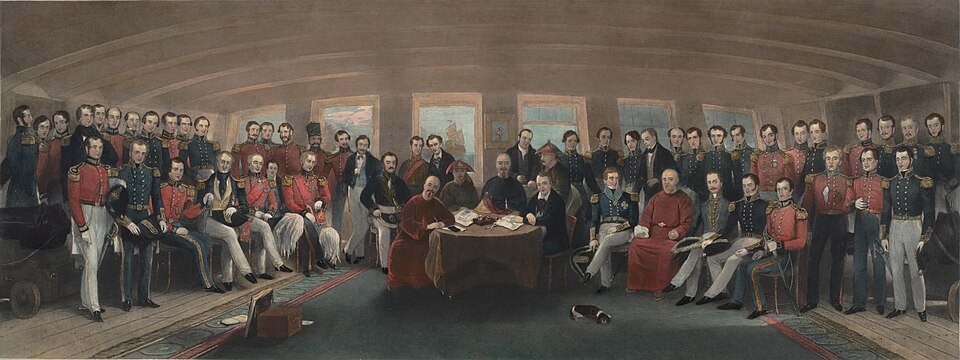
Military defeat enabled foreign powers to impose ports, indemnities and legal privileges that restricted Chinese sovereignty.
Background
Trade enforced through military power
Treaty ports were created within an unequal relationship between the Qing state and foreign powers. Britain and other states used naval force and the threat of renewed war to secure commercial access, settlements and privileges. Calling the resulting documents treaties does not mean they were agreements between equally powerful or freely consenting parties.[2]
What happened
- 1842–1843
Nanjing and the supplementary settlement
After the First Opium War, the Treaty of Nanjing opened five ports, ceded Hong Kong and imposed an indemnity. Supplementary arrangements gave British subjects extraterritorial privileges. Other powers obtained comparable concessions, establishing a system in which foreigners could escape ordinary Chinese legal jurisdiction.[1]
- 1858–1901
An expanding network
Further military defeats brought additional ports, inland access and foreign-controlled districts. Shanghai became the most prominent treaty-port city, but the system extended far beyond it. Concessions and leased territories were not all governed identically: their legal arrangements and degrees of foreign control varied.[2]
Impact & evidence
Sovereignty divided in everyday life
Foreign commercial privileges affected customs revenue, policing, courts and urban government. Chinese residents supplied the labour and trade that made these cities prosper while facing unequal access to political authority. Urban growth and cultural exchange therefore developed alongside coercion and legal discrimination, not outside them.[2]
Aftermath & legacy
Beyond the endpoint of this overview
The 1901 Boxer settlement imposed further payments and foreign military rights. It did not end treaty-port imperialism. Subsequent nationalist movements contested the arrangements, and their dismantling occurred in stages. The 1842–1901 period describes the system's forceful establishment and expansion rather than its complete lifespan.[3]
Sources & image credits (3)
- Wikipedia — Unequal treaties ↗
- Catherine Ladds: China and treaty-port imperialism ↗
- Boxer Protocol: treaty text held by the Library of Congress ↗
Painted by Captain John Platt, Bengal Volunteers. Engraved by John Burnet. Image source ↗