Underground Railroad networks
Freedom seekers and their allies built varied routes out of slavery despite laws enforcing recapture.
- When
- Late eighteenth–mid-nineteenth centuries
- Where
- United States, Canada, Mexico and other destinations
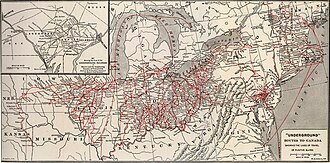
Freedom seekers and their allies built varied routes out of slavery despite laws enforcing recapture.
Background
Escape began with enslaved people
The Underground Railroad was not a railway or a single centrally managed organisation. It describes networks of people, places and assistance used in escapes from slavery. Freedom seekers made the crucial decisions and took the greatest risks; helpers mattered without displacing their agency.[2]
What happened
- Before the Civil War
Routes depended on local knowledge
Escape could involve walking, boats, concealment or forged documents. Trusted contacts might provide shelter, information and onward travel, but many people had to act with little support. The geography of ports, rivers and work connections shaped opportunities differently in each region.[3]
Impact & evidence
Different destinations for freedom
Canada was important, but routes also led to Mexico, maritime destinations and places within the United States. Legal status and the danger of recapture differed. A line on a modern map cannot fully convey how uncertain, improvised and dangerous a journey could be.[2]
Aftermath & legacy
Evidence and remembrance
Secrecy protected participants but left gaps in the record. Testimony, correspondence and documented sites help distinguish established routes from later local legends. Remembering the Underground Railroad requires attention to ordinary freedom seekers as well as famous figures such as Harriet Tubman, and to the system of slavery that made escape necessary.[3]
Sources & image credits (3)
- Wikipedia — Underground Railroad ↗
- National Park Service: what the Underground Railroad was ↗
- Encyclopedia Virginia: Underground Railroad networks in Virginia ↗
https://lccn.loc.gov/68003375 Siebert, Wilbur Henry, 1866-1961. The underground railroad from slavery to freedom . With an introd. by Albert Bushnell Hart. Gloucester, Mass., P. Smith, 1968 [c1898] xxvi, 478 p. illus., facsim., fold. map, ports. 21 cm. E450 .S57 1968 Image source ↗