Trail of Tears: Cherokee removal
The forced expulsion of the Cherokee Nation despite widespread opposition to removal.
- When
- 1838–1839
- Where
- Southeastern United States to Indian Territory, now Oklahoma
US troops and state militias removed Cherokee people from their homes, held them in stockades and sent them west. The government relied on a treaty signed by a minority without the elected Cherokee leadership's authority. Thousands died amid removal and its hardships.
Background
Pressure for Cherokee land
Federal removal policy sought Indigenous land for white settlement. The Cherokee had an established government and institutions; removal destroyed homes and livelihoods rather than moving an unattached population.[1]
What happened
- 1835–1836
A disputed treaty
A minority signed the Treaty of New Echota. More than 15,000 Cherokee protested, but the US Senate ratified it in May 1836.[2]
- May 1838
Roundup and confinement
Federal troops and state militias gathered Cherokee families into stockades. Many were forced to leave home with little time to prepare or gather possessions.[2]
- 1838–1839
Journeys west
People travelled along multiple land and water routes. Hunger, illness and exposure made the journey deadly; the National Park Service commonly cites approximately 4,000 Cherokee deaths.[1]
Impact & evidence
Removal records
The US National Archives holds records of the removal but warns that there is no comprehensive list of all participants. An incomplete archive cannot account fully for every family or loss.[3]
Aftermath & legacy
Continuing nationhood
Cherokee people continued their political and cultural life after removal; some remained in the eastern homeland. The story forms part of a wider removal policy affecting other nations, each with its own history.[1]
A forced journey, then the work of rebuilding
The route was a network of land and river journeys, with detention and delays adding to the toll. Reaching Indian Territory ended the journey but not the losses. Cherokee communities rebuilt political and cultural life around a new capital at Tahlequah while some Cherokee remained in the east. Survival should not be confused with consent to removal.[1]
Sources & image credits (3)
- National Park Service — Trail of Tears overview ↗
- National Park Service — What happened on the Trail of Tears? ↗
- US National Archives — Cherokee removal records ↗
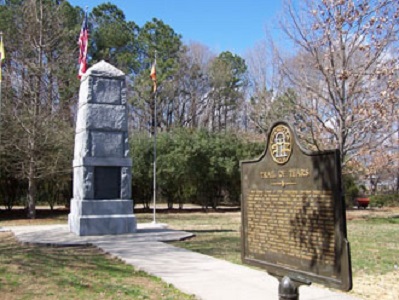
Stephen Conn, via National Park Service. Image source ↗