Canadian residential-school system
The separation of Indigenous children from families to suppress cultures and identities.
- When
- 19th–20th centuries
- Where
- Canada
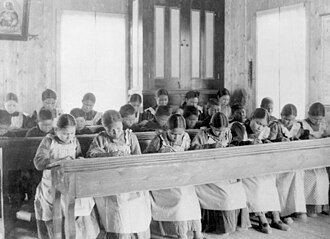
Canada's residential-school system removed First Nations, Inuit and Métis children from their communities. Government policy and church administration pursued assimilation. Survivors described abuse, neglect, forced labour and suppression of languages; many children never returned home.
Background
Separation as policy
By the 1880s the federal government funded a residential-school system intended to distance children from family and culture. The National Centre for Truth and Reconciliation records more than 150,000 children attending.[1]
Separation was the method
Children were often sent far from home, punished for speaking their languages and subjected to substandard education, neglect and abuse. Distance and institutional authority weakened family oversight. The policy’s assimilative aim was consequently built into daily practices, rather than being an unintended effect of ordinary schooling.[1]
What happened
- 1920
Compulsory attendance
An Indian Act amendment made residential-school attendance compulsory for Treaty-status children aged seven to fifteen. Legal coercion reinforced the system's reach.[1]
- During the system
Labour and neglect
The Truth and Reconciliation Commission's history describes schooling repeatedly displaced by work needed to maintain institutions. This undermined claims that children's education was the overriding purpose.[2]
- 2008 and after
Apology and testimony
Canada issued a federal apology in 2008. Survivors' legal action helped bring compensation mechanisms and the Truth and Reconciliation Commission, whose work documented the system and proposed action.[1]
Impact & evidence
An institutional record
The commission combined records with testimony to explain how schools attacked family relationships, languages and Indigenous nations. Its analysis identifies a system rather than isolated misconduct.[2]
Aftermath & legacy
Different experiences and remedies
Settlement arrangements did not encompass every affected group. The NCTR notes exclusions and later separate settlements, including those concerning Métis survivors, Newfoundland and Labrador schools, and federal day schools.[1]
The settlement did not include every survivor
The NCTR explains that the settlement agreement was not comprehensive: Métis Nation survivors were excluded, while other groups later pursued separate settlements. An apology or a compensation programme therefore cannot stand in for the experience of everyone affected. Survivor testimony remains essential to understanding both institutional harm and gaps in redress.[1]
Sources & image credits (2)
- National Centre for Truth and Reconciliation — Residential school history ↗
- Truth and Reconciliation Commission — History, Volume 1, Part 1 ↗
BiblioArchives / LibraryArchives from Canada; CC BY 2.0; via Wikimedia Commons. Image source ↗