Stolen Generations
The removal of Aboriginal and Torres Strait Islander children under discriminatory policies.
- When
- 19th–20th centuries; policies varied by jurisdiction
- Where
- Australia
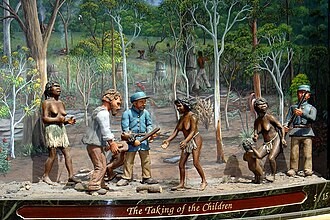
Australian governments and institutions separated Indigenous children from families and communities. The national Bringing Them Home inquiry recorded the consequences for survivors and descendants, including damage to family relationships, language, identity and belonging.
Background
Power over families
Removal policies and practices differed across states and territories. Their common setting was government control over Indigenous lives, with officials determining where children would live and who would raise them.[1]
What happened
- During removal policies
Separation and placement
Children were placed in institutions and other households, often far from relatives. Survivors' accounts show how separation disrupted the passing of language, culture and family knowledge.[1]
- 1997
Bringing Them Home
The national inquiry published its findings on the separation of Aboriginal and Torres Strait Islander children from their families. Testimony made personal experience central to the public record.[3]
- 1997 and after
A programme for redress
The report made 54 recommendations covering acknowledgment, reparations, records, family reunion and changes to law and services.[2]
Impact & evidence
Reparations beyond payment
The recommendations treated reparation broadly, including acknowledgment, restitution, rehabilitation and guarantees against repetition. Financial compensation was one part of a larger response.[2]
The scale of forced separation
Bringing Them Home concluded that between one in ten and one in three Indigenous children were removed from their families and communities between approximately 1910 and 1970. The range reflects uneven and incomplete records. It measures removal, not deaths, and should not be converted into a precise nationwide count without further evidence.[4]
Aftermath & legacy
Reconnection and continuity
Access to family records and support for reunion can help repair relationships disrupted by removal. The report recognised Indigenous organisations doing this work and called for support for their role.[2]
Reunion required records and support
For survivors seeking relatives, access to institutional records could determine whether reunion was possible. Reparation therefore included preserving information, helping families reconnect and addressing long-term psychological and cultural harm. The report’s recommendations linked the past to practical responsibilities for governments and services.[2]
Sources & image credits (4)
- Australian Human Rights Commission — Bringing Them Home, national overview ↗
- Australian Human Rights Commission — Report recommendations ↗
- Australian Human Rights Commission — About the inquiry ↗
- humanrights.gov.au — historical research ↗
The original uploader was Bjenks at English Wikipedia .; Attribution; via Wikimedia Commons. Image source ↗