Shaanxi earthquake
An earthquake whose destruction of settlements and loess dwellings produced one of history's largest reported disaster tolls.
- When
- 23 January 1556
- Where
- Shaanxi and neighbouring regions, China
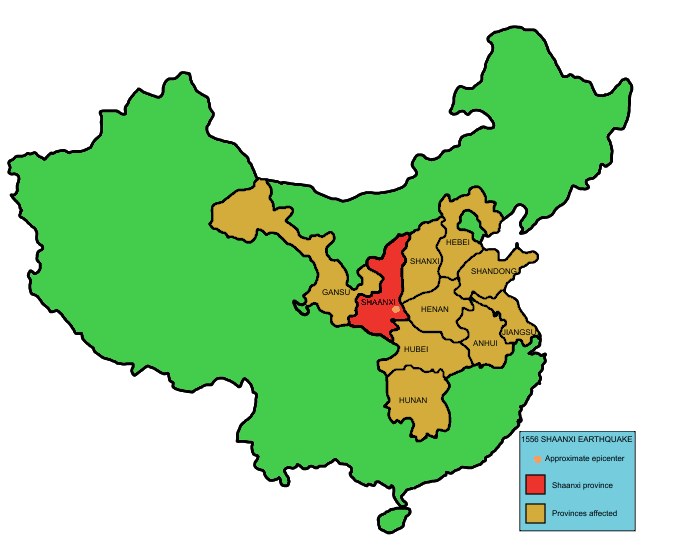
An earthquake whose destruction of settlements and loess dwellings produced one of history's largest reported disaster tolls. Parts of northern China contained thick deposits of windblown soil, with dwellings cut into slopes as well as built above ground. These forms could offer practical advantages in ordinary conditions.
Background
Settlements in a loess landscape
Parts of northern China contained thick deposits of windblown soil, with dwellings cut into slopes as well as built above ground. These forms could offer practical advantages in ordinary conditions. Strong shaking, however, could collapse cliffs, cave homes and unstable ground over a wide area.[1]
What happened
- 23 January 1556
Destruction around Huaxian
A major earthquake struck during the Ming dynasty. Historical accounts describe ruined towns, fissures and landslides. The event predates instrumental seismology, so its magnitude and extent are reconstructed from descriptions rather than measured directly.[1]
- After the shaking
Losses spread beyond collapsed buildings
Survivors faced destroyed shelter, disrupted food supplies and damaged local administration. Such conditions complicate historical mortality figures: immediate crushing deaths and subsequent hardship may be combined in later accounts. Records were also uneven across the affected districts.[1]
Impact & evidence
A historical estimate, not a census
USGS repeats a reported toll of 830,000. This figure is widely cited, but its precision exceeds what surviving records can securely establish. It should be understood as a historical reported total, not a modern verified count or an exact measure of deaths caused directly by shaking.[2]
Aftermath & legacy
Reading an exceptional catastrophe
The earthquake remains important to the study of seismic risk and settlement vulnerability. Its account is most useful when the physical hazard and the quality of the evidence are explained together. A dramatic ranking alone hides both the landscape conditions that magnified destruction and the uncertainty in the numbers.[1]
Sources & image credits (2)
Roke, via Wikimedia Commons. · CC BY-SA 3.0 (source record). Resized for display. Image source ↗