Indian rebellion and British reprisals
A major uprising against Company rule met with devastating British reprisals.
- When
- 1857–1858
- Where
- Northern and central India
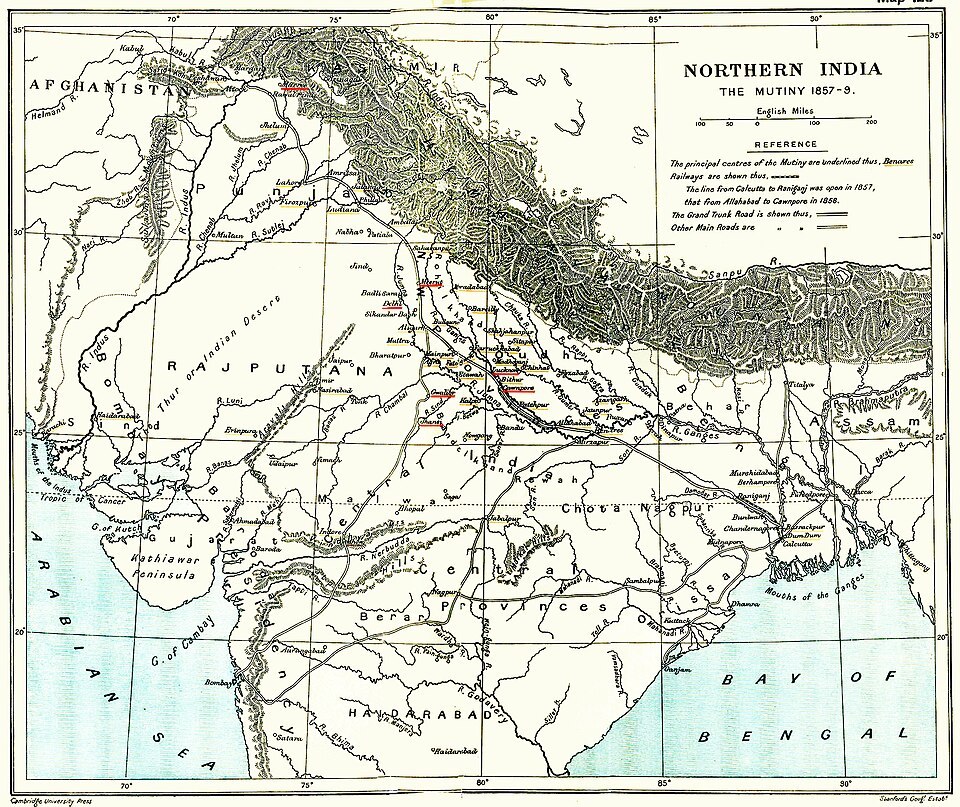
A major uprising against Company rule met with devastating British reprisals.
Background
Grievances beyond the cartridges
Military grievances interacted with annexation, land policies and fears of interference with religion. The cartridge controversy was an immediate trigger, not a complete explanation for the varied participation of soldiers, dispossessed rulers and civilians.[3]
What happened
- 1857
An uprising spread
The revolt began at Meerut in May and spread to Delhi and other centres. Rebel forces attacked British military and civil authority. Killings of British civilians, including at Cawnpore, became central to British demands for vengeance.[2]
- 1857–1858
A revolt with several centres
Delhi gave the rebellion an imperial symbol in the ageing Mughal emperor. Fighting also centred on places including Lucknow, Kanpur and Jhansi. Participation and aims varied: soldiers’ grievances, threatened rulers and rural opposition did not form a single centrally directed movement, and many Indian forces continued to serve the British.[3]
Impact & evidence
Reprisals against wider populations
British forces carried out executions and collective punishments. The museum records the terror remembered as the “Devil’s Wind.” Civilian suffering extended beyond those who had fought, while the overall mortality cannot be reduced to a securely established single count.[2]
Aftermath & legacy
Company rule ended in 1858
The Crown assumed direct government of British India. The army and administrative relationships were reorganised, but colonial rule continued. The uprising’s different regional experiences later supported competing imperial and nationalist interpretations.[1]
Sources & image credits (3)
- Wikipedia — Indian Rebellion of 1857 ↗
- National Army Museum: decisive events of the Indian Rebellion ↗
- National Army Museum: causes of the rebellion ↗
Unknown author Unknown author Cambridge University Press; Stanford's Geogl. Estabt.. · Public domain Image source ↗