The development of Braille
Making reading and writing accessible through a compact tactile code.
- When
- 1824–19th century
- Where
- France; international adoption
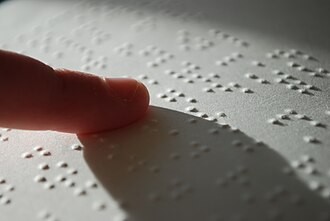
Louis Braille developed a six-dot system that could be read by touch. Its adoption gave blind readers and writers a means of engaging directly with written language, later extended to specialist notation and electronic displays.
Background
Designing for touch
Earlier raised-print systems were cumbersome. A small cell of distinguishable dot patterns could place information within the reach of a fingertip.[1]
What happened
Impact & evidence
Six dots that could be read by touch
Louis Braille adapted a more cumbersome twelve-dot system into a six-dot cell while still a teenager. Different combinations could represent characters compactly enough to be recognised with a fingertip. The system also developed forms for mathematics and music. Its adoption was gradual: an effective invention still had to overcome institutional resistance and become available through teaching and books.[1]
Aftermath & legacy
Reading and independence
Braille remains a form of literacy, not merely a substitute for spoken information. Its continued adaptation shows how accessibility can shape the design of communication technology.[1]
Sources & image credits (1)
Stefan Malmesjö; CC BY 2.0; via Wikimedia Commons. Image source ↗