Circassian expulsion
Russian conquest driving Circassian communities from their homeland into deadly exile.
- When
- 1860s, culminating in 1864
- Where
- Northwestern Caucasus and Ottoman destinations
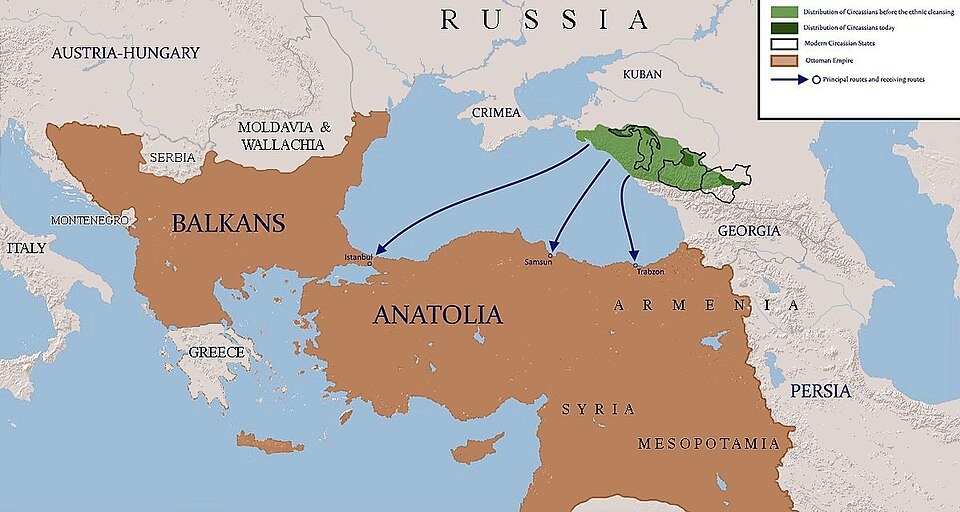
Russian conquest driving Circassian communities from their homeland into deadly exile. The Russian Empire fought a prolonged campaign to control the northwestern Caucasus. Circassian communities resisted, while imperial authorities increasingly treated removal of the population as a means of securing territory.
Background
Imperial expansion into the Caucasus
The Russian Empire fought a prolonged campaign to control the northwestern Caucasus. Circassian communities resisted, while imperial authorities increasingly treated removal of the population as a means of securing territory. Military conquest became inseparable from decisions about who would be permitted to remain on the land.[1]
What happened
- Early 1860s
Villages destroyed and people displaced
Russian forces cleared settlements and pushed inhabitants toward the Black Sea coast or designated resettlement areas. Loss of homes, food supplies and shelter exposed people to hunger and disease before they even boarded ships. Removal was imposed under military pressure rather than undertaken as ordinary voluntary migration.[1]
- 1864 and afterward
Exile across the Black Sea
Large numbers were transported to Ottoman territory. Overcrowded vessels and poorly supplied coastal camps increased mortality. Those who survived faced further resettlement, separating communities across different parts of the Ottoman Empire and creating a wide Circassian diaspora.[1]
Impact & evidence
Do not equate expulsion with death
Estimates of the expelled and dead vary greatly because they cover different years and populations and rely on incomplete records. Very high figures circulate, but a single precise toll cannot be established from this evidence. The scale of dispossession is clear even when the number killed directly, lost at sea or dead from disease cannot be confidently separated.[2]
Aftermath & legacy
A homeland remembered in diaspora
The events are commemorated by Circassian communities as genocide. Recognition, return and preservation of language remain connected to the expulsions. An account centred only on the Russian military victory would omit the destruction of civilian life and the consequences carried by survivors and their descendants.[1]
Sources & image credits (2)
Ercwlff · CC BY-SA 3.0 (source record). Resized for display. Image source ↗