Castle Bravo and its fallout
An American thermonuclear test that exposed inhabited islands and a fishing vessel to fallout.
- When
- 1 March 1954 and its aftermath
- Where
- Bikini Atoll and neighbouring Marshall Islands
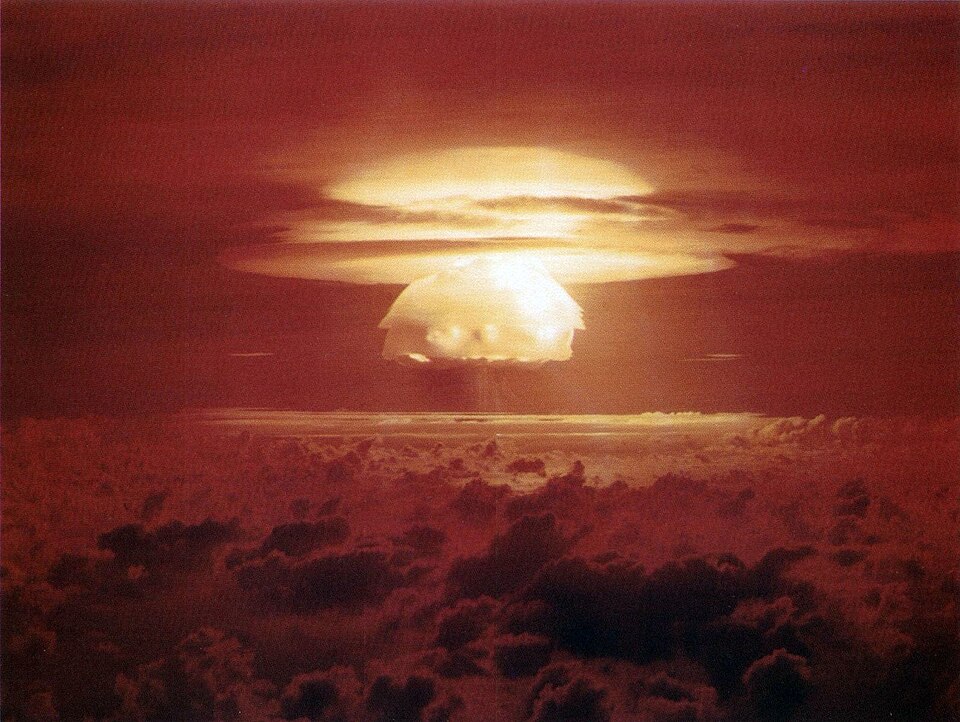
The United States detonated Castle Bravo at Bikini Atoll with a yield of about fifteen megatons. Radioactive fallout spread beyond the test area, reaching Marshallese communities and the Japanese fishing vessel Lucky Dragon No. 5. The consequences included exposure, displacement and prolonged disputes over health and responsibility.
Background
Testing in an inhabited ocean
The Pacific testing grounds were surrounded by islands that were homes, fishing grounds and sources of food. A boundary drawn around a weapons test could not contain radioactive particles carried by the atmosphere. The relationship between military planning and the rights of island communities is central to this history.[1]
What happened
- 1 March 1954
A fifteen-megaton explosion
Castle Bravo produced an exceptionally large thermonuclear explosion. Fallout contaminated areas outside the immediate test site, exposing people who had not been protected from its arrival.[3]
- March 1954 onward
Fallout reaches communities
Residents of Rongelap and Utrik were among those affected, along with the crew of Lucky Dragon No. 5. The episode made the international consequences of atmospheric testing unmistakable. Exposure and evacuation were followed by long-term medical and environmental questions.[1]
Impact & evidence
Health evidence and its limits
Studies reconstruct doses using test records, environmental evidence and people’s locations and diets. Exposure differed greatly between islands and individuals. A population-wide projection of later cancer risk is not a list of identifiable deaths, and it should not be presented as an exact mortality count.[3]
Aftermath & legacy
An obligation that outlasted the test
The US Department of Energy’s Marshall Islands programme includes medical and environmental responsibilities connected with the testing legacy. These continuing arrangements reflect consequences extending well beyond the day of detonation. For islanders, the history involves land, food and displacement as well as radiation measurements.[2]
Sources & image credits (3)
- US Department of Energy — Atmospheric testing history ↗
- US Department of Energy — Marshall Islands programme ↗
- Scientific review — Marshall Islands fallout exposures ↗
United States Department of Energy; Public domain Image source ↗