Battle of Plassey
A Company victory that opened the way to British political control in Bengal.
- When
- 23 June 1757
- Where
- Bengal, South Asia
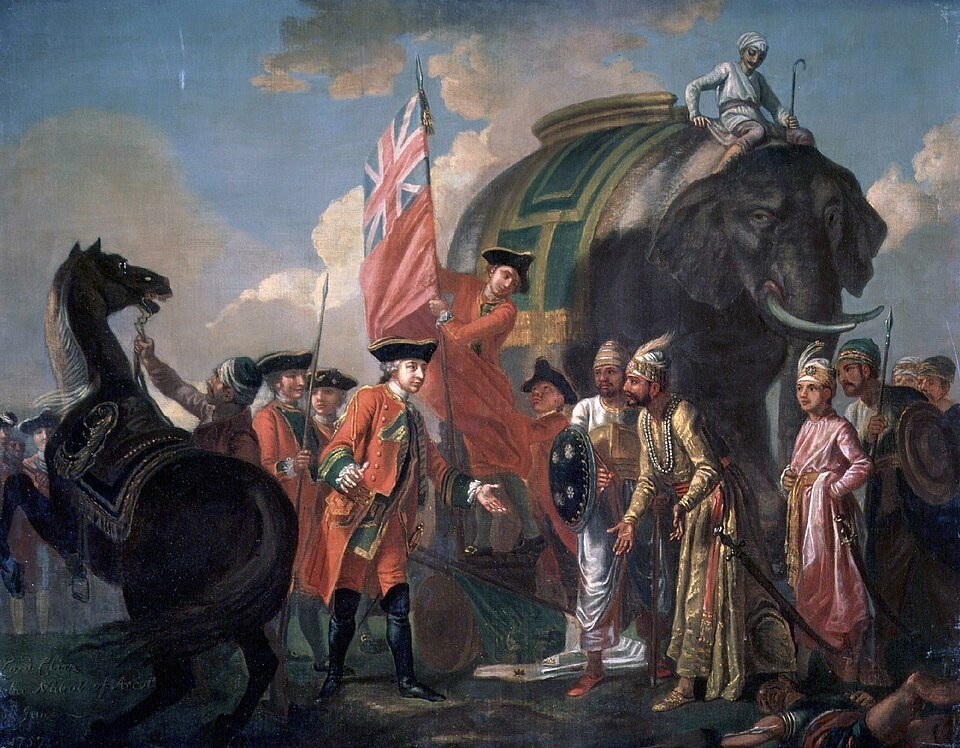
A Company victory that opened the way to British political control in Bengal. The East India Company operated fortified trading settlements in Bengal. Its conflict with Nawab Siraj-ud-Daulah grew amid disputes over fortifications and commercial privileges, while Britain and France fought a wider imperial war.
Background
A trading company becomes a military power
The East India Company operated fortified trading settlements in Bengal. Its conflict with Nawab Siraj-ud-Daulah grew amid disputes over fortifications and commercial privileges, while Britain and France fought a wider imperial war. After the nawab captured Calcutta in 1756, Robert Clive's forces recovered it and moved against French influence in the region.[1]
What happened
- 1757
Conspiracy before battle
Clive negotiated with opponents of the nawab, including the commander Mir Jafar. The agreement offered a change of ruler in exchange for support and financial concessions. This political preparation mattered as much as battlefield tactics: a substantial part of the nawab's force would not fight decisively for him when the armies met near Palashi, known to the British as Plassey.[1]
- 23 June 1757
The nawab's army breaks
The Company force defeated the nawab despite being outnumbered. Rain affected the fighting, but the withholding of support by senior commanders was central to the result. Siraj-ud-Daulah fled and was subsequently killed; Mir Jafar became nawab under the influence of the Company and its allies.[1]
Impact & evidence
Victory purchased political leverage
The Company received money and expanded its influence over Bengal's government. Plassey did not instantly give it formal revenue administration throughout the province: the Battle of Buxar and the grant of diwani rights in 1765 were later steps. Distinguishing these stages explains how commercial privileges developed into territorial rule.[2]
Aftermath & legacy
A turning point with an uneven legacy
British imperial accounts celebrated Clive's victory, while the political arrangement gave a private corporation increasing power over taxation and government. The battle's wider significance rests in this transformation, rather than in the size of the engagement alone. Bengal's subsequent exploitation and food crises require attention to those developing institutions, not an assumption that every later policy began on the battlefield.[1]
Sources & image credits (2)
Francis Hayman · Public domain (source record). Resized for display. Image source ↗