Battle of Adwa
Ethiopian forces defeating Italy's attempt to impose colonial control.
- When
- 1 March 1896
- Where
- Adwa, Ethiopia
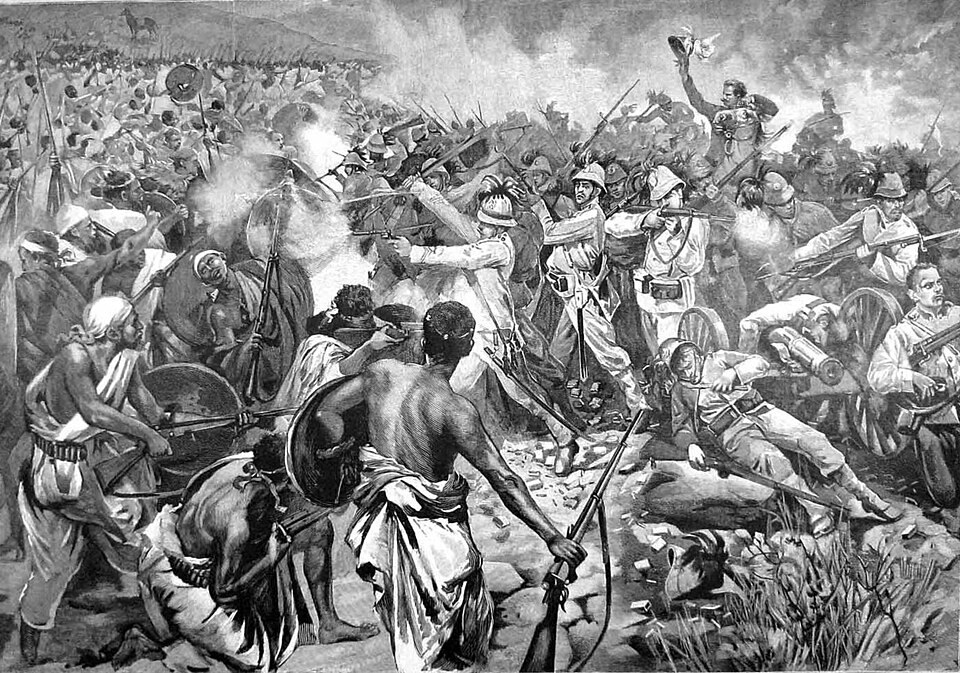
Ethiopian forces defeating Italy's attempt to impose colonial control. The 1889 Treaty of Wuchale had different implications in its Italian and Amharic versions. Italy interpreted it as establishing a protectorate, while Emperor Menelik II rejected the claim that Ethiopia had surrendered control of its foreign affairs.
Background
A disputed treaty
The 1889 Treaty of Wuchale had different implications in its Italian and Amharic versions. Italy interpreted it as establishing a protectorate, while Emperor Menelik II rejected the claim that Ethiopia had surrendered control of its foreign affairs. The dispute developed into war as Italian forces advanced from Eritrea.[1]
What happened
- 1895–1896
Mobilisation across Ethiopia
Menelik assembled a large army supported by regional commanders and extensive supply networks. Empress Taytu played an important role in the campaign. Ethiopian victories and resistance before Adwa undermined the Italian advance; the final battle was the culmination of mobilisation and strategy rather than an isolated surprise.[1]
- 1 March 1896
The Italian advance collapses
Italian columns moved into difficult terrain and became separated. Ethiopian forces attacked and defeated them around Adwa. The Italian army suffered thousands of casualties and many prisoners were taken. Ethiopian losses were also substantial; commemorating the victory should not obscure the cost borne by its soldiers and communities.[1]
Impact & evidence
Recognition of independence
The subsequent Treaty of Addis Ababa ended the war and recognised Ethiopia's independence. Italy's protectorate claim failed, though its colony of Eritrea remained. Adwa therefore secured an important political outcome without ending European colonial rule elsewhere in the region.[2]
Aftermath & legacy
A victory with international meaning
At a time of rapid European conquest in Africa, Adwa challenged claims that imperial domination was inevitable. It became an important reference for African and diaspora political movements. Ethiopia nevertheless faced another Italian invasion in 1935, showing that the 1896 settlement did not permanently remove imperial ambitions or the need to defend sovereignty.[1]
Sources & image credits (2)
The Graphic , from details supplied by survivors · Public domain (source record). Resized for display. Image source ↗