Amistad revolt and legal case
Africans who seized the Amistad won release after courts rejected claims that they were lawful property.
- When
- 1839–1841
- Where
- Atlantic Ocean, Cuba and United States courts
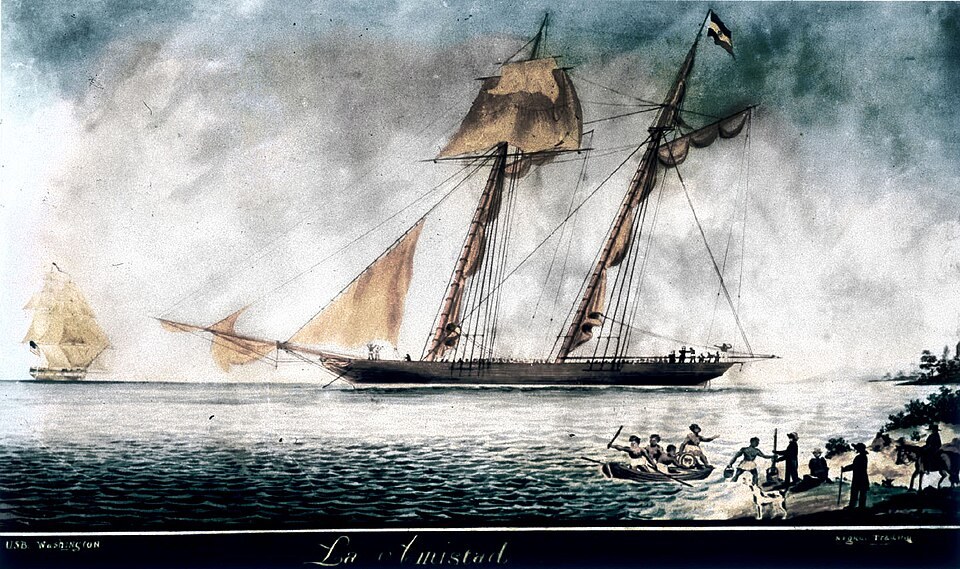
Africans who seized the Amistad won release after courts rejected claims that they were lawful property.
Background
Kidnapping concealed by false ownership claims
The captives had been taken from Africa and trafficked to Cuba despite restrictions on the transatlantic trade. Papers presented them as people lawfully enslaved in Cuba. Their own origins and testimony became central to challenging those claims.[1]
What happened
- 1839
The captives take control
Led by Sengbe Pieh, also known as Cinqué, the Africans revolted aboard the Amistad and demanded to be taken home. The vessel instead reached waters near the United States, where they were detained. A struggle for freedom at sea became a contest in American courts.[2]
- 1841
The Supreme Court orders release
The Court concluded that the Africans were free people unlawfully kidnapped and entitled to resist. Abolitionist support and legal advocacy, including John Quincy Adams's participation, helped the case. But the captives' resistance and evidence were fundamental, not merely a pretext for a famous lawyer's achievement.[3]
Impact & evidence
The ruling did not abolish slavery
The judgment turned on illegal trafficking and the captives' status. It did not declare all slavery unconstitutional. Some justices involved later supported decisions protecting slaveholders, demonstrating why this victory should not be presented as the Court's general rejection of slavery.[3]
Aftermath & legacy
Returning home
Survivors raised funds and returned to Africa. Others had died during captivity and proceedings. The case became a powerful abolitionist example while leaving the wider slave system intact; individual liberation and structural abolition remained different achievements.[1]
Sources & image credits (3)
- Wikipedia — United States v. The Amistad ↗
- National Archives: habeas corpus records for the Amistad Africans ↗
- National Archives: Incited by the Love of Liberty ↗
La_Amistad_(ship).jpg : Unknown author derivative work: TheCuriousGnome ( talk ) Image source ↗