Agra famine
Crop failure and loss of access to food devastated the central Doab.
- When
- 1837–1838
- Where
- North-Western Provinces, Company-ruled India
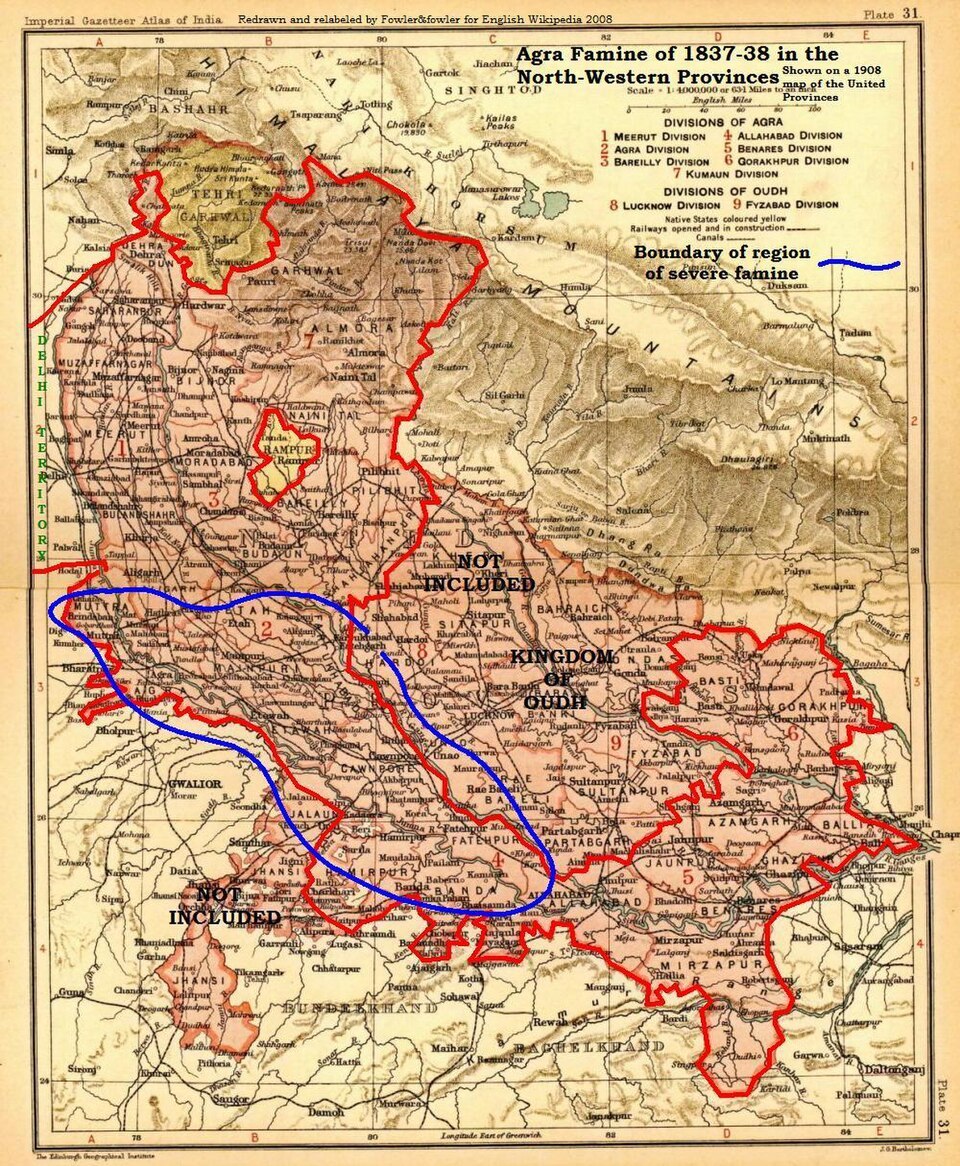
Crop failure and loss of access to food devastated the central Doab.
Background
An agrarian population under Company rule
Drought struck a region dependent on seasonal harvests. The hardest-hit districts included Agra, Kanpur, Etawah and neighbouring areas. Households’ ability to survive depended on wages, grain prices, reserves and the relief available, not rainfall alone.[1]
What happened
- 1837–1838
Harvest failure became a food crisis
As supplies tightened, people sold possessions, migrated and sought work or assistance. Loss of livestock weakened both immediate survival and the capacity to cultivate after the crisis.[1]
- 1837–1838
Relief depended on work and administration
Company officials used public works, charity and revenue measures during the crisis. Access was uneven, and exhausted or ill people could struggle to reach assistance or perform labour. The famine exposed the limits of treating a collapse in food access as a temporary shortage that households could endure until the next harvest.[1]
Impact & evidence
An estimated 800,000 deaths
Historical summaries commonly estimate about 800,000 deaths in an affected population of roughly eight million. This is a retrospective estimate for the famine region, not a complete register or a count confined to the city of Agra.[1]
Aftermath & legacy
Relief and administrative learning
Public works and other relief measures exposed questions about when government should intervene and who could access assistance. Later colonial famine policy drew on such experiences, without preventing further catastrophic failures.[1]
Sources & image credits (1)
The original uploader was Fowler&fowler at English Wikipedia . · Public domain Image source ↗