Tambora eruption
A colossal eruption causing mass death locally and disrupting climate and harvests far beyond Indonesia.
- When
- April 1815; climatic effects in 1816
- Where
- Sumbawa, Indonesia; global effects
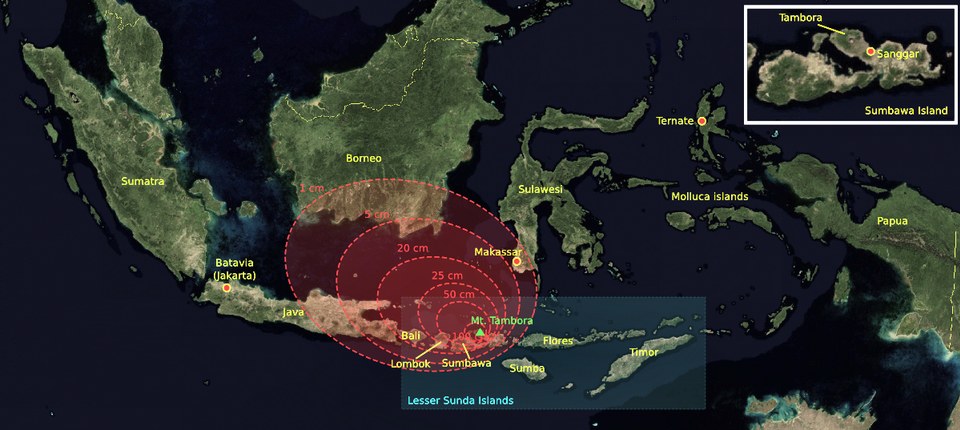
A colossal eruption causing mass death locally and disrupting climate and harvests far beyond Indonesia. Mount Tambora stood on Sumbawa, where communities farmed and traded around the volcano. Activity increased before the main explosions.
Background
An inhabited volcanic landscape
Mount Tambora stood on Sumbawa, where communities farmed and traded around the volcano. Activity increased before the main explosions. People close to the mountain faced direct volcanic hazards, while the wider consequences would arise from material injected high into the atmosphere.[1]
What happened
- 10–11 April 1815
The eruption reaches its peak
Explosions and pyroclastic flows devastated nearby settlements. Ash covered land and damaged water and food supplies. The eruption removed much of the mountain's summit and formed a large caldera; its scale greatly exceeded familiar twentieth-century eruptions such as Mount St Helens.[1]
- 1815–1816
Hunger and climatic disruption
Survivors in the region faced ruined harvests, disease and starvation. Sulfur compounds in the stratosphere contributed to global cooling, producing unusual weather and harvest failures in distant regions. The following year became known in parts of Europe and North America as the year without a summer.[1]
Impact & evidence
Direct and indirect losses
A USGS account describes more than 70,000 deaths in surrounding areas; other compilations give higher estimates. Most losses included famine and disease after the eruption, not only immediate burial or burns. Deaths associated with distant harvest failures cannot be added into a precise global total with confidence.[2]
Aftermath & legacy
A connected climate catastrophe
Tambora demonstrates how a local geological event can affect food systems across continents. Climate was not the only influence on suffering: conflict, trade, poverty and relief capacity also mattered. The event's global reach should not overshadow the destruction of communities nearest the volcano.[1]
Sources & image credits (2)
Indon; reworked by Nyks, using NASA base imagery and Oppenheimer (2003) ashfall contours. · CC BY-SA 3.0 (source record). Resized for display. Image source ↗