Mothers of the Plaza de Mayo
Mothers publicly demanding answers about people disappeared by Argentina's dictatorship.
- When
- From 1977
- Where
- Buenos Aires, Argentina
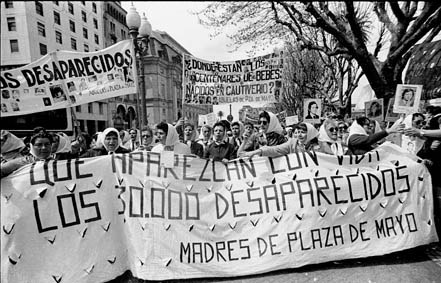
Mothers publicly demanding answers about people disappeared by Argentina's dictatorship. Argentina's military dictatorship abducted people into clandestine detention, denying families reliable information about their fate. Disappearance prevented ordinary legal remedies and spread fear.
Background
Disappearance concealed state violence
Argentina's military dictatorship abducted people into clandestine detention, denying families reliable information about their fate. Disappearance prevented ordinary legal remedies and spread fear. Mothers searching through official channels found that individual inquiries were ignored or met with intimidation.[1]
What happened
- 30 April 1977
A public gathering
A group of women assembled in the Plaza de Mayo to demand information about their missing children. Their repeated presence outside the centre of government transformed private searches into a visible challenge. White headscarves became a recognisable symbol of a movement that insisted the missing were people with names and families.[1]
- During dictatorship
Persistence under threat
Members faced surveillance and repression; some were themselves abducted and killed. The movement continued to gather, document cases and attract international attention. Its demand for truth challenged the state's attempt to remove victims from public knowledge as well as from physical society.[1]
Impact & evidence
Refusing enforced silence
The Mothers did not possess a complete official record of the disappeared. Their importance lay partly in making absence publicly undeniable and maintaining pressure for investigation. The wider toll of dictatorship is a separate historical question; it should not be represented as the number of members or relatives documented by one organisation.[2]
Aftermath & legacy
Justice, memory and differences
After civilian government returned, campaigns continued over accountability and remembrance. The movement later divided organisationally, and its members did not hold identical political views. Its founding achievement remains the creation of a persistent public space in which families could confront official denial and demand responsibility.[1]
Sources & image credits (2)
Archivo Hasenberg-Quaretti · CC BY-SA 3.0 (source record). Resized for display. Image source ↗