Founding of the Non-Aligned Movement
Newly independent states organised for autonomy amid Cold War rivalry.
- When
- 1961
- Where
- Belgrade, Yugoslavia, and participating states
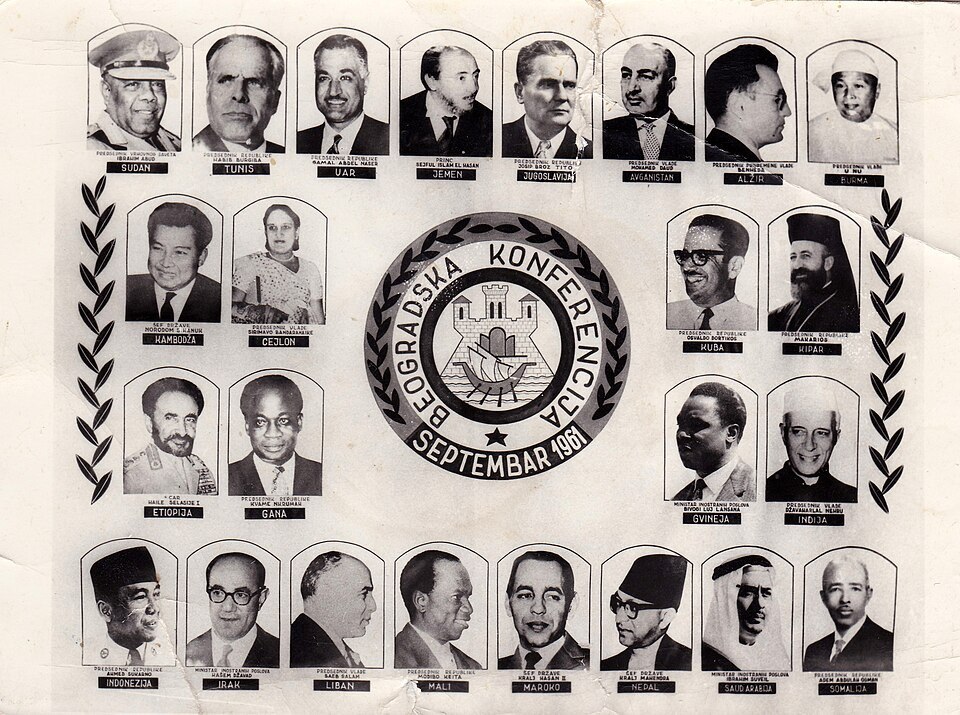
Newly independent states organised for autonomy amid Cold War rivalry.
Background
Decolonisation changed diplomacy
Asian, African and other states sought space to pursue their interests without formal subordination to either Cold War bloc. The Bandung conference and earlier cooperation helped prepare the ground for a broader movement.[1]
What happened
- September 1961
The first summit
Leaders met in Belgrade to establish the Non-Aligned Movement. Figures including Tito, Nehru, Nasser, Sukarno and Nkrumah represented different political systems and national priorities.[1]
- 1–6 September 1961
Twenty-five states met in Belgrade
The first summit brought together 25 participating states. Decolonisation, disarmament, sovereignty and economic inequality linked countries whose governments and alliances otherwise differed considerably. The meeting gave these states a platform for collective diplomacy at a time when international politics was often presented through the rivalry of two superpowers.[1]
Impact & evidence
Non-alignment was not identical neutrality
Members opposed colonial rule and advocated sovereignty and development, but their relations with the superpowers varied. The movement was a diplomatic forum rather than a unified military alliance or proof that every member avoided outside dependence.[1]
Cooperation without a founding treaty
The movement’s official history identifies Belgrade as its first summit and traces its principles to Bandung. It developed as a political forum without a founding charter or permanent secretariat, using successive summits and rotating leadership to coordinate countries seeking independence from the rival Cold War blocs.[2]
Aftermath & legacy
A durable collective voice
Its importance lay partly in widening who could shape international agendas. Internal disagreements and authoritarian practices in some member states complicate a celebratory account. Shared opposition to domination did not guarantee common policies or equal treatment within each country.[1]
Sources & image credits (2)
Unknown author Unknown author · Public domain Image source ↗