Colombia's government–FARC peace agreement
A negotiated attempt to end the war between the Colombian government and the FARC.
- When
- 2016
- Where
- Colombia
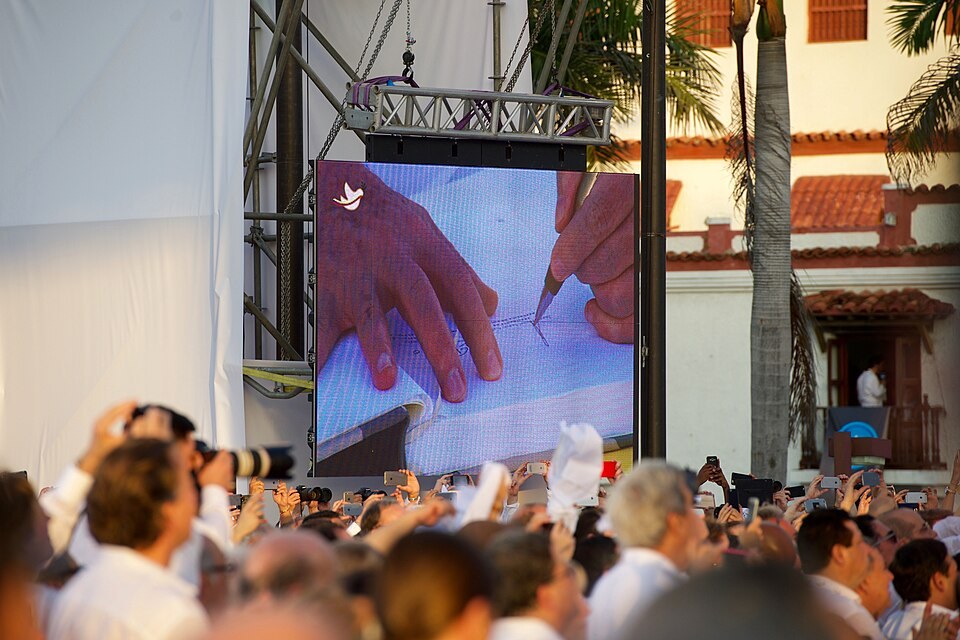
A negotiated attempt to end the war between the Colombian government and the FARC. Colombia's armed conflict involved land inequality, insurgency, state violence, paramilitary organisations and illicit economies. The FARC was a major participant, but not the only armed actor.
Background
A long war with several causes
Colombia's armed conflict involved land inequality, insurgency, state violence, paramilitary organisations and illicit economies. The FARC was a major participant, but not the only armed actor. Negotiations beginning in 2012 therefore addressed one central conflict relationship without promising to eliminate every source of violence in the country.[1]
What happened
- 2012–2016
Negotiations in Havana
Talks developed provisions on rural reform, political participation, drugs, victims and ending the conflict. Victims' participation and gender-related commitments shaped the agreement. The process sought to connect disarmament with changes in the conditions that had sustained war.[1]
- 2016
Rejection followed by revision
A public referendum narrowly rejected an initial agreement. Negotiators revised the text, and a final agreement was signed in November and approved through Congress. The sequence matters: the settlement was not simply the direct implementation of a successful referendum.[1]
Impact & evidence
Different measures of progress
The accord created mechanisms for laying down arms, reintegration and accountability, including a special peace jurisdiction. Implementation of rural and political commitments proved more difficult. Continued violence by other groups and against social leaders does not erase the agreement's achievements, but prevents describing it as the end of all Colombian conflict.[2]
Aftermath & legacy
A peace process judged over time
The agreement's significance depends on both reduced warfare with the former FARC and delivery of its wider promises. Verification and victims' rights remain central to evaluating it. A balanced account separates the text's commitments, completed measures and outstanding failures instead of treating signature as a finished peace.[1]
Sources & image credits (2)
- Wikipedia — Colombian peace process ↗
- United Nations Colombia — Progress and continuing structural challenges ↗
U.S. Department of State from United States · Public domain (source record). Resized for display. Image source ↗