Contents
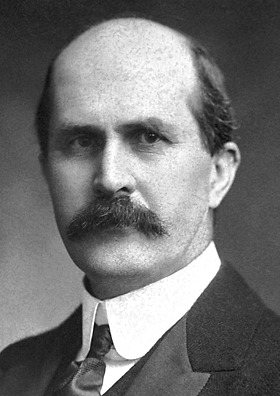
William Henry Bragg
Developing X-ray crystallography with his son, revealing how atoms are arranged in crystals.
Studies in Radioactivity · X-ray spectrometer
- Born
- 2 July 1862
- Birthplace
- Westward, United Kingdom
- Died
- 12 March 1942
More people
William Henry Bragg
William Henry Bragg was a British physicist who worked in Australia and Britain. He shared the 1915 Nobel Prize in Physics with his son Lawrence for their work on crystal structure.
Early life
Cumbrian childhood
Was raised partly by an uncle after his mother died.
Cambridge mathematics
Studied at Trinity College before taking a university post in Australia.
Career
- 1886
Adelaide
Began teaching mathematics and physics at the University of Adelaide.
- 1909
Leeds
Returned to Britain as a physics professor.
- 1915
London and Nobel Prize
Moved to University College London and shared the physics award.
- 1923
Royal Institution
Became director of the Davy Faraday Research Laboratory.
Contributions
Studies in Radioactivity
Presented research on radiation and its interaction with matter.
X-ray spectrometer
Developed an instrument for investigating X-ray reflections from crystals.
X Rays and Crystal Structure
Published with Lawrence Bragg an account of their new analytical method.
Beyond physics
Public science
Delivered Royal Institution Christmas Lectures for young audiences.
Sport
Helped establish lacrosse in South Australia and also played tennis and golf.
Sources & photo credit
Life, career and references ↗Further source: nobelprize.org ↗Photo: Nobel foundation. Public domain · Original image. Cropped and displayed in monochrome.
