Contents
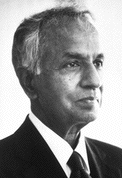
Subrahmanyan Chandrasekhar
Discovering the mass limit beyond which a white dwarf cannot support itself.
Chandrasekhar limit · Nobel Prize 1983
- Born
- 19 October 1910
- Birthplace
- Lahore, British India
- Died
- 21 August 1995
More people
Subrahmanyan Chandrasekhar
Subrahmanyan Chandrasekhar was an Indian-American astrophysicist who studied the structure and evolution of stars. He shared the 1983 Nobel Prize in Physics with William Fowler.
Early life
Family and education
Born in Lahore, he grew up in a family that included his uncle, physicist C. V. Raman.
Madras to Cambridge
Studied at Presidency College in Madras before travelling to Cambridge in 1930.
Career
- 1930s
A stellar limit
Calculated how relativity changes the support available inside a white dwarf.
- 1937
Chicago career
Joined the University of Chicago, where he spent the rest of his career.
- 1952–1971
Journal editor
Edited The Astrophysical Journal alongside his research.
- 1983
Physics Nobel
Received recognition for theoretical work on stellar structure and evolution.
Contributions
Chandrasekhar limit
Established a maximum mass of roughly 1.4 Suns for a typical white dwarf supported by electron pressure.
Radiative Transfer
Developed mathematical treatments of radiation moving through matter.
The Mathematical Theory of Black Holes
Presented a detailed study of black-hole physics.
Beyond physics
Lalitha Chandrasekhar
Married Lalitha Doraiswamy in 1936; they had met while studying in Madras.
Chandra observatory
NASA named its Chandra X-ray Observatory in his honour.
Sources & photo credit
Life, career and references ↗Nobel Prize biography and award ↗Photo: Startchild Project NASA. Public domain · Original image. Cropped and displayed in monochrome.
.gif)