Contents
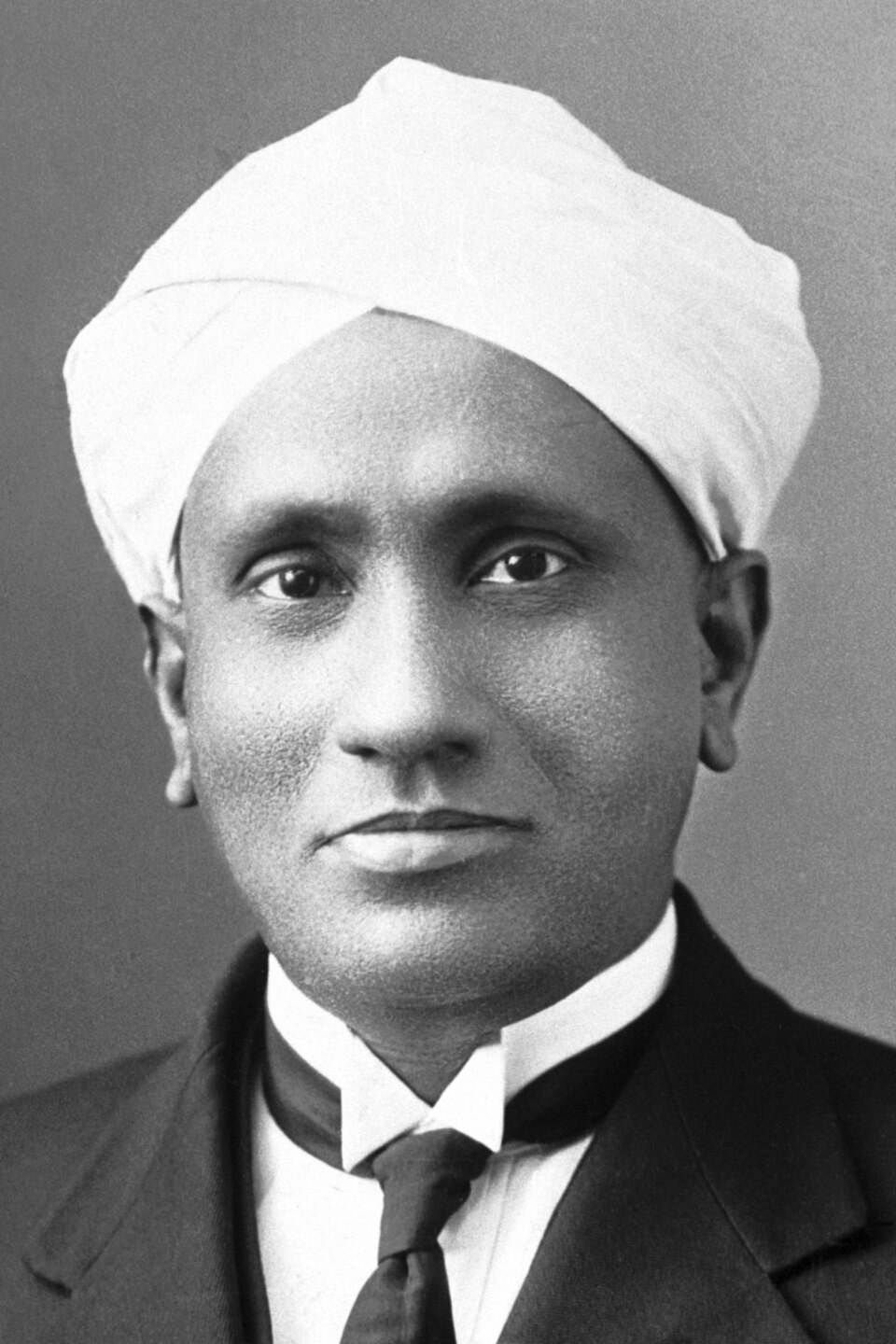
C. V. Raman
Discovering how scattered light reveals the molecules it meets.
The Raman effect · Nobel Prize in Physics
- Born
- 7 November 1888
- Birthplace
- Tiruchirappalli, India
- Died
- 21 November 1970
More people
C. V. Raman
C. V. Raman was an Indian physicist who studied light, sound and crystals. His experiments with K. S. Krishnan revealed a change in light scattered by matter. The discovery earned him the 1930 Nobel Prize in Physics and became the basis of Raman spectroscopy.
Early life
A teacher’s household
Grew up with a father who taught mathematics and physics.
Madras education
Studied physics at Presidency College, completing his master’s degree in 1907.
Career
- 1907
Civil servant and researcher
Worked in the Indian Finance Department while conducting experiments in Calcutta.
- 1917
Full-time professor
Left government service for the Palit professorship at the University of Calcutta.
- 1933
Indian Institute of Science
Moved to Bangalore to become its director and lead physics research.
- 1948
Independent institute
Founded the Raman Research Institute, where he continued experimental work.
Contributions
Musical acoustics
Studied the vibrations of instruments, including Indian drums.
Raman effect
With K. S. Krishnan, observed light changing frequency when scattered.
Physics Nobel
Received the prize for light scattering and the effect named after him.
Beyond the lab
Family
Married Lokasundari in 1907; they had two sons.
A school of researchers
Mentored physicists including G. N. Ramachandran, who later studied protein structures.
Sources & photo credit
Biography ↗Nobel biography ↗Nobel discovery ↗Photo: Nobel Foundation. Public domain · Original image. Cropped and displayed in monochrome.
