Contents
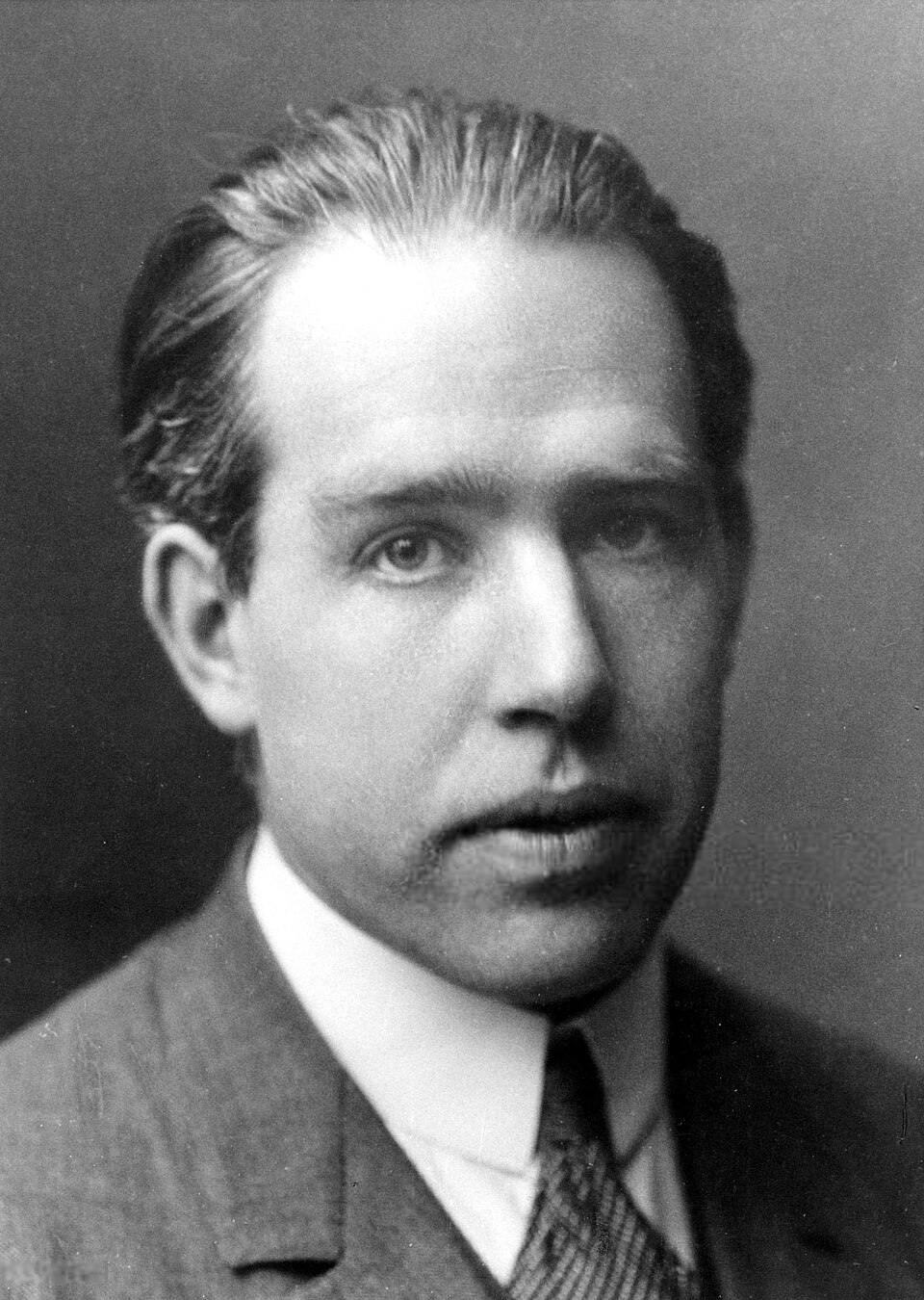
Niels Bohr
Explaining atomic energy levels and helping establish quantum physics.
The Bohr model · Complementarity
- Born
- 7 October 1885
- Birthplace
- Copenhagen, Denmark
- Died
- 18 November 1962
More people
Niels Bohr
Niels Bohr showed how an atom’s electrons could occupy distinct energy states. His Copenhagen institute became a meeting place for the physicists developing a new, often counterintuitive account of matter.
Early life
An academic household
His father was a physiology professor, and discussion of science and philosophy was part of family life in Copenhagen.
Experimental beginnings
At university he studied physics and won a prize for experiments on surface tension before turning to the theory of electrons.
Career
- 1911–1913
Towards an atomic model
After his doctorate, work in Britain brought him into contact with Ernest Rutherford and the nuclear atom.
- 1921–1922
An institute and a Nobel Prize
He led Copenhagen’s new theoretical-physics institute and received the 1922 physics prize.
- 1927–1930s
Debating quantum mechanics
He developed complementarity and debated the interpretation of quantum theory with Albert Einstein.
- 1943–1950
War and its consequences
After escaping occupied Denmark, he advised the wartime atomic project and later argued for international openness about nuclear technology.
Contributions
The Bohr model
Electrons occupy allowed energy states; transitions between them account for characteristic light from atoms.
Complementarity
Different experimental arrangements reveal aspects of quantum systems that cannot simply be combined into a classical picture.
Nuclear fission theory
With John Archibald Wheeler, he developed a theoretical account of the fission process.
Beyond the lab
Science in the family
His son Aage Bohr also became a physicist and shared the 1975 Nobel Prize in Physics.
Football before fame
He played football as a young man; his brother Harald Bohr combined international football with a mathematical career.
Sources & photo credit
Life and career ↗Institutional or specialist reference ↗Photo: The American Institute of Physics credits the photo [1] to AB Lagrelius & Westphal , which is the Swedish company used by the Nobel Foundation for most photos of its book series Les Prix Nobel .. Public domain · Original image. Cropped and displayed in monochrome.
