Contents
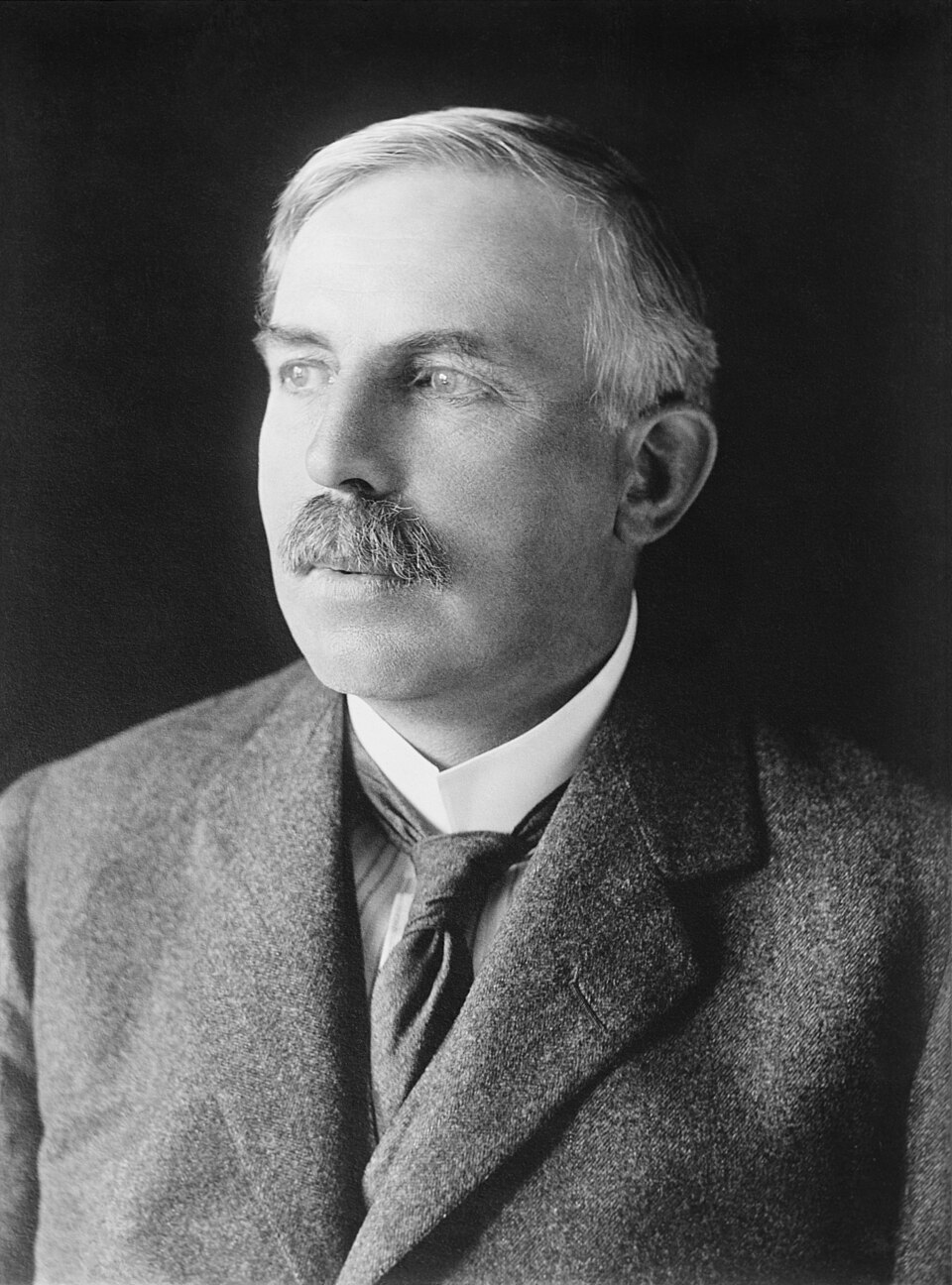
Ernest Rutherford
Revealing the tiny nucleus at the centre of the atom.
Radioactive decay · Nobel Prize
- Born
- 30 August 1871
- Birthplace
- Brightwater, New Zealand
- Died
- 19 October 1937
More people
Ernest Rutherford
Ernest Rutherford was a New Zealand physicist whose experiments transformed ideas about radioactivity and atomic structure.
Early life
New Zealand
Grew up in a large family in the Nelson and Marlborough regions.
Scholarships
Studied at Nelson College and Canterbury College before research at Cambridge.
Career
- 1898
McGill University
Moved to Montreal to lead research on radioactivity.
- 1907
Manchester
Became professor of physics and developed his nuclear model.
- 1919
Cavendish Laboratory
Returned to Cambridge as laboratory director.
Contributions
Radioactive decay
With Frederick Soddy, explained how radioactive elements transform.
Nobel Prize
Received the chemistry prize for work on radioactive substances.
Nuclear atom
Interpreted scattering experiments as evidence of a small, dense nucleus.
Beyond the lab
Mentorship
His laboratories trained researchers including Niels Bohr and James Chadwick.
Remembrance
Buried in Westminster Abbey; element rutherfordium honours his name.
Sources & photo credit
Life, career and references ↗Institutional biography and research ↗Photo: Bain News Service, publisher Restored by: Bammesk. Public domain · Original image. Cropped and displayed in monochrome.
